What do you do with a hallway that is long, dark, and too narrow for two people to pass — and could 12 narrow Victorian hallway ideas turn that passage into the warmest welcome in the house? Victorian halls were built for drama, not daylight: high ceilings, carved cornices, encaustic tiles, and stained glass, all squeezed into a corridor that can feel more like a tunnel than a room.
This collection covers the whole hall, from the tiles under your feet to the ceiling rose above your head, with slim consoles, runners, mirrors, and lighting that suit a narrow period space. Most take an afternoon or less. Start at one end and work your way down.
1. Narrow Victorian Hallway Ideas: Let the Encaustic Tiles Lead
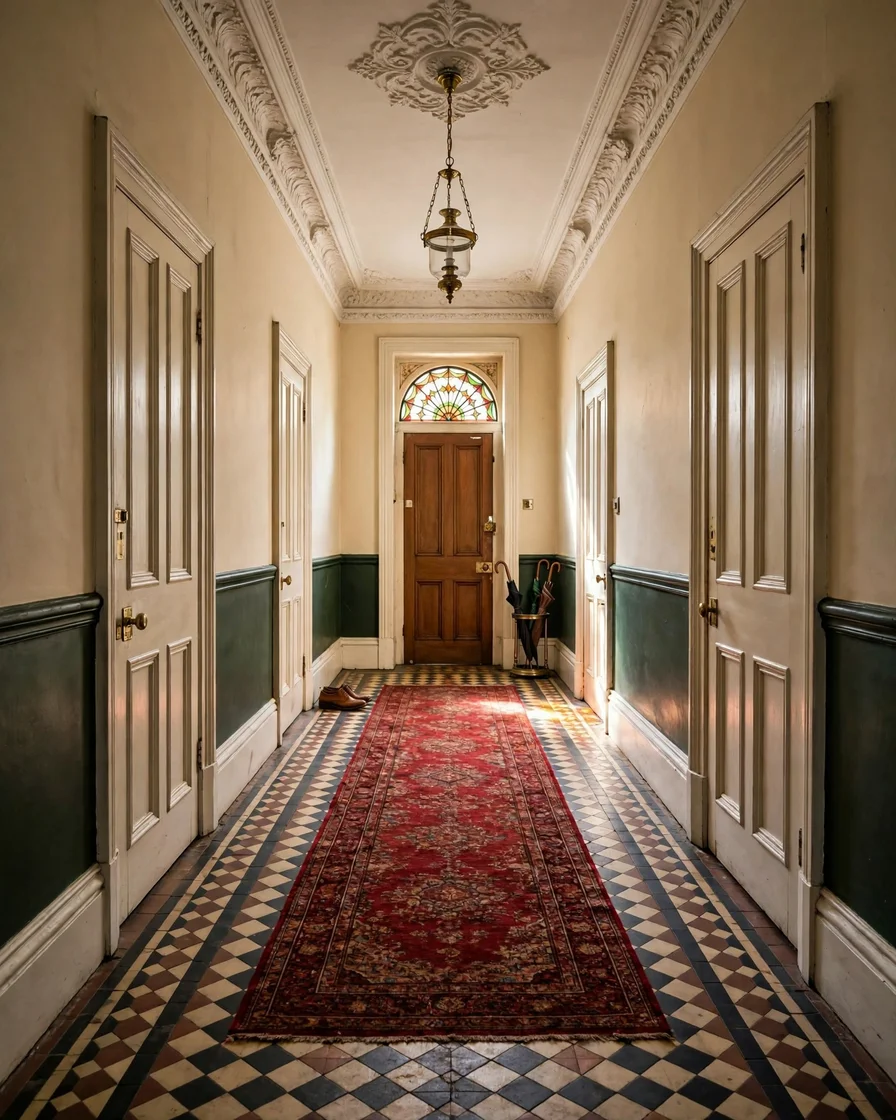
The floor is the first thing your eye meets in a long hall, so start there. In the photo, black, cream, and brown encaustic tiles in a checkerboard pattern run the full length of the hall, with a deep red patterned runner laid down the middle, dark green dado rails, and a wooden front door with a stained-glass fanlight at the far end. A brass umbrella stand and a pair of brown shoes sit by the door, and an ornate ceiling rose holds a brass lantern pendant overhead. If your tiles are hiding under carpet, lift a corner and check what is underneath before you plan anything else. Clean the tiles with warm soapy water, let them dry fully, then seal them so the colors stay rich. Lay the runner on a non-slip underlay, leaving a border of tile showing on both sides. Cleaning and sealing takes a weekend afternoon, while laying the runner takes under an hour. For a budget-friendly version, hunt for a secondhand runner and clean the tiles yourself instead of hiring a restorer.
Quick Tip: Leave at least a hand’s width of tile showing on each side of the runner so the pattern frames it.
2. Fit a Slim Console Table Under an Arched Mirror
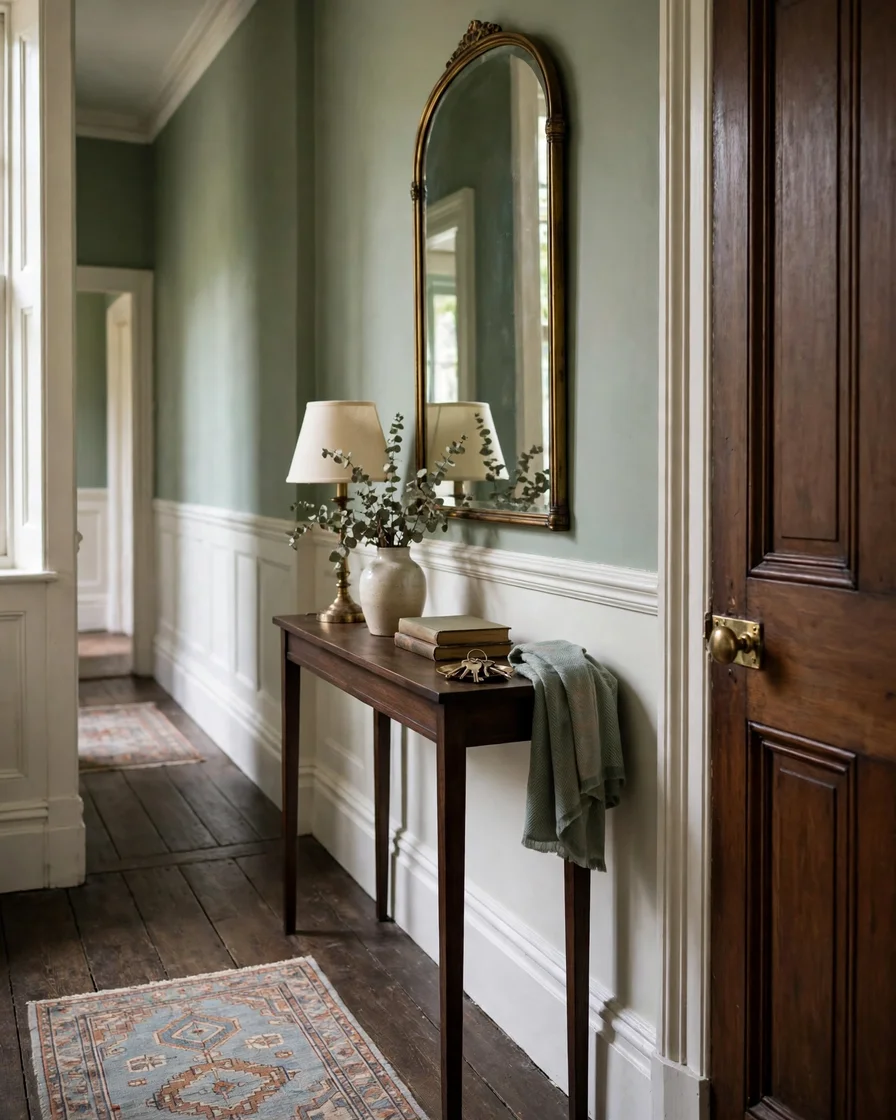
A console table is the one piece of furniture a narrow hall can take without blocking the way, as long as it stays slim. In the photo, a dark-wood console barely deeper than a book stands against a sage-green wall, with a tall arched mirror in a brass frame above it, a brass lamp with a cream shade, a ceramic vase of dried eucalyptus, two stacked books, and a small brass dish holding keys. A green throw hangs over one end of the table, and a patterned rug runs along the dark wood floor. Measure your hall first and pick a table no deeper than 25 centimeters, so two people can still pass. Hang the mirror so its center sits at eye level, then set the lamp at one end and the vase at the other. Keep the middle of the table clear for keys and post. The whole setup takes about an hour. For a budget-friendly version, look for a secondhand console and mirror and polish the brass yourself. These hallway mirror ideas show more shapes that suit a narrow wall.
Quick Tip: Fix the console to the wall with a small bracket so it cannot tip if someone brushes past it.
3. Paint the Walls Pale to Widen a Narrow Victorian Hallway
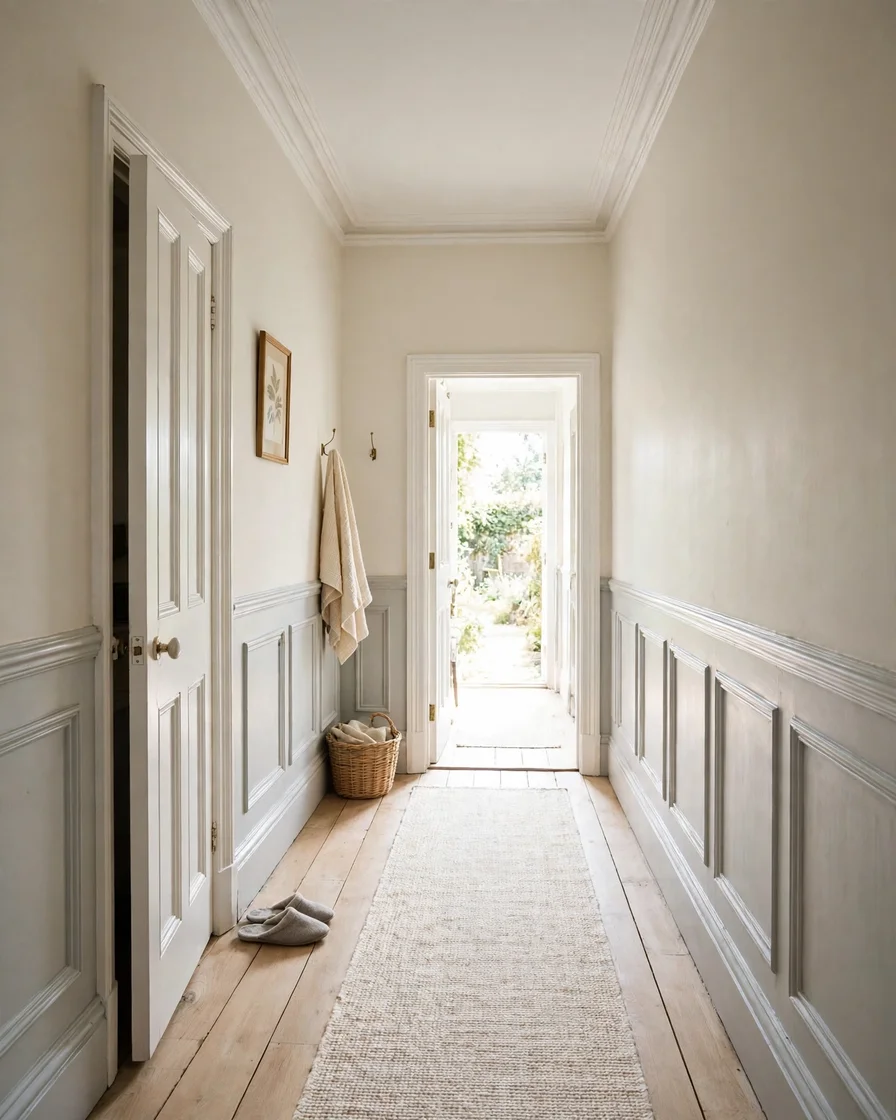
Pale paint is the fastest way to make a narrow hall feel wider, because light walls push the sides of the corridor apart. In the photo, warm off-white walls sit above a crisp white dado rail, with pale grey panelling below, pale oak floorboards, and a cream woven runner leading to a bright doorway at the far end. A white panelled door stands ajar on one side, a framed botanical print hangs on the wall, and a wicker basket and a pair of grey slippers sit by the skirting board. Start by washing the walls down and filling any cracks, then paint the ceiling white first so drips fall on bare walls. Roll two coats of off-white above the dado, and paint the panelling below in a slightly deeper shade of the same color family. Painting the whole hall takes a weekend, including drying time. For a budget-friendly version, buy one tin of off-white and use it on the walls, ceiling, and woodwork, changing only the finish.
Quick Tip: Test your paint on a large card and move it along the hall before you commit, since hallway light changes from end to end.
4. Pair Panelling With Patterned Wallpaper Above the Dado
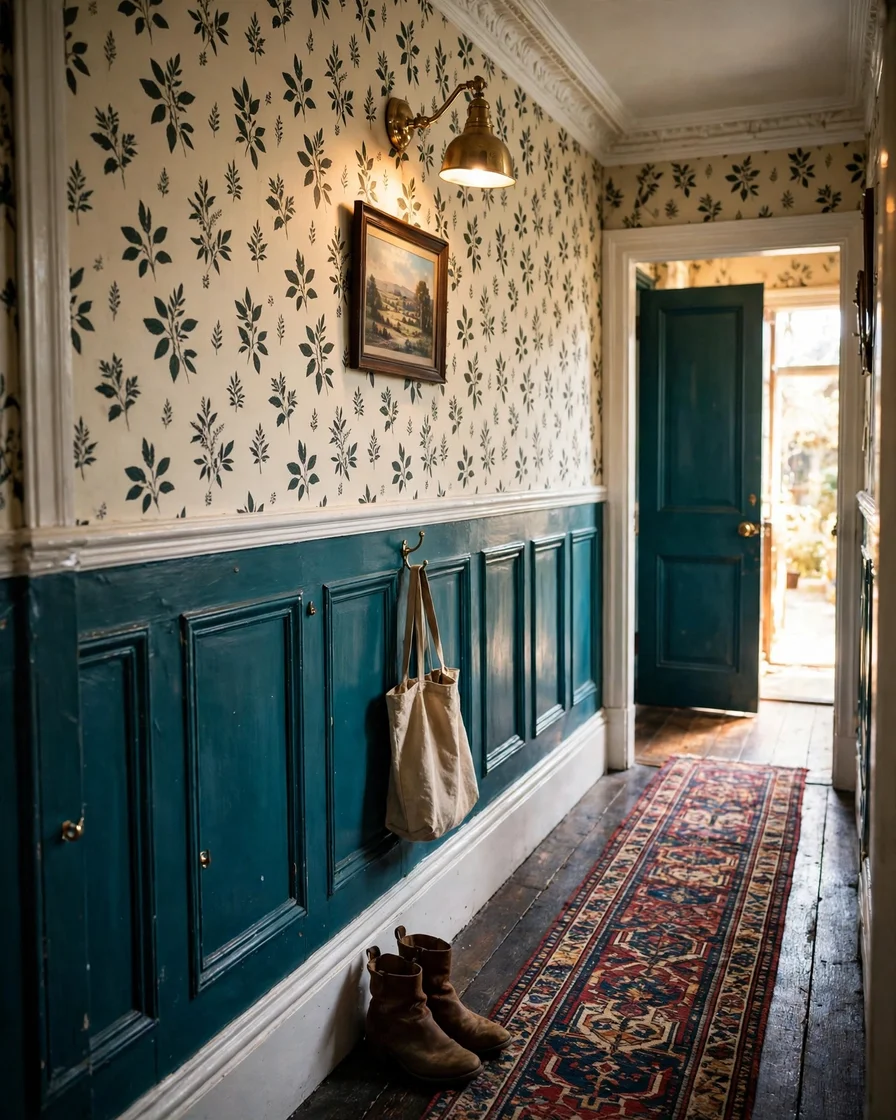
Half-height panelling with wallpaper above is the classic Victorian wall, and it suits a narrow hall because the dado rail breaks up the long run. In the photo, deep teal painted panelling fills the wall below a white dado rail, while cream wallpaper with a dark green botanical leaf pattern covers the wall above. A brass picture light glows over a framed landscape print, a canvas tote hangs from a brass hook, brown boots wait by the skirting board, and a red and blue patterned runner runs along the dark wood floor. Paper the upper wall first, working from the dado rail upward so the pattern lines up at the rail. Then paint the panelling below in a color pulled from the wallpaper. Hang the picture light above a print to pull the eye along the hall. Papering and painting one wall takes a weekend. For a budget-friendly version, paper one long wall only and paint the other in a plain color from the same palette. These hallway panelling and wallpaper ideas show more pairings that work in tight spaces.
Quick Tip: Pick a small-scale wallpaper pattern for a narrow hall, since a large print closes the walls in.
5. Layer Wall Lights and a Pendant for a Dark Hall
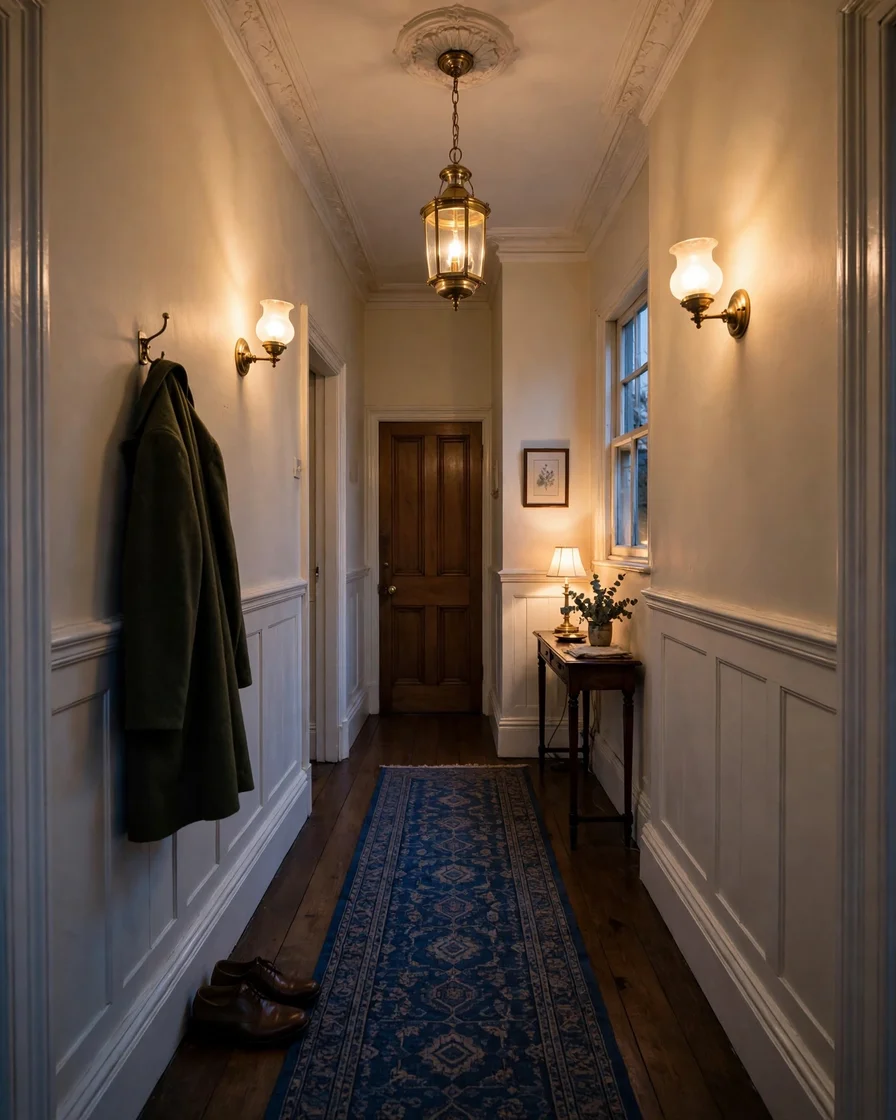
One ceiling light leaves a long hall gloomy at both ends, so layer three sources of light instead. In the photo, a brass lantern pendant hangs from a ceiling rose, two brass wall lights with frosted glass shades glow on the cream walls, and a small table lamp burns on a slim console at the far end, warming a blue patterned runner on the dark wood floor. A green coat hangs on a brass hook, brown shoes sit by the white panelling, and a framed botanical print catches the light. Start with the pendant in the middle of the hall, then add wall lights at eye level, staggered on opposite walls so the light overlaps instead of lining up. Finish with a lamp at the far end so the hall never ends in darkness. Fitting the lights takes an afternoon, with an electrician for the wiring. For a budget-friendly version, use plug-in wall lights and a lamp you already own. These narrow hallway lighting ideas show more ways to brighten a windowless hall.
Quick Tip: Put every light on the same warm bulb color so the hall glows evenly instead of patchy.
6. Let the Stained-Glass Fanlight Do the Talking
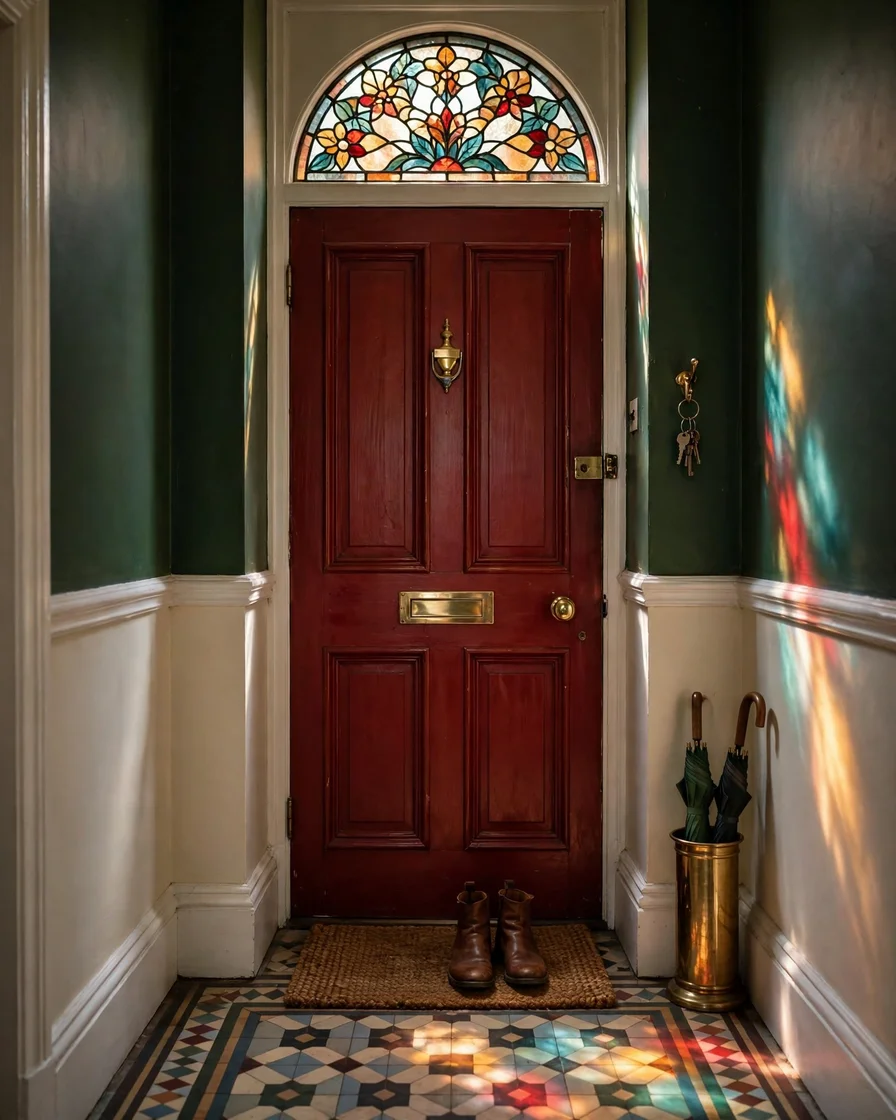
A stained-glass fanlight is the best free decoration a Victorian hall owns, and all it needs is clean glass and clear sightlines. In the photo, a deep red panelled front door with a brass letterbox, knob, and knocker sits under an arched fanlight of amber, ruby, and teal glass in a floral pattern, throwing patches of colored light across the dark green walls and the encaustic tiled floor. A brass umbrella stand holds two umbrellas, brown boots wait on a woven mat, and keys hang from a small brass hook beside the door. Start by cleaning the glass inside and out with warm soapy water, and check the putty around each pane for cracks. If your fanlight was replaced with plain glass, fit a stained-glass effect film cut to the arch. Cleaning takes about an hour; fitting film takes an afternoon. For a budget-friendly version, use the film on plain glass and polish the brass door furniture instead of replacing it.
Quick Tip: Keep the area in front of the door clear so the colored light can fall on the floor where you can see it.
7. Hang Coats on a Wall Rail Above a Slim Bench
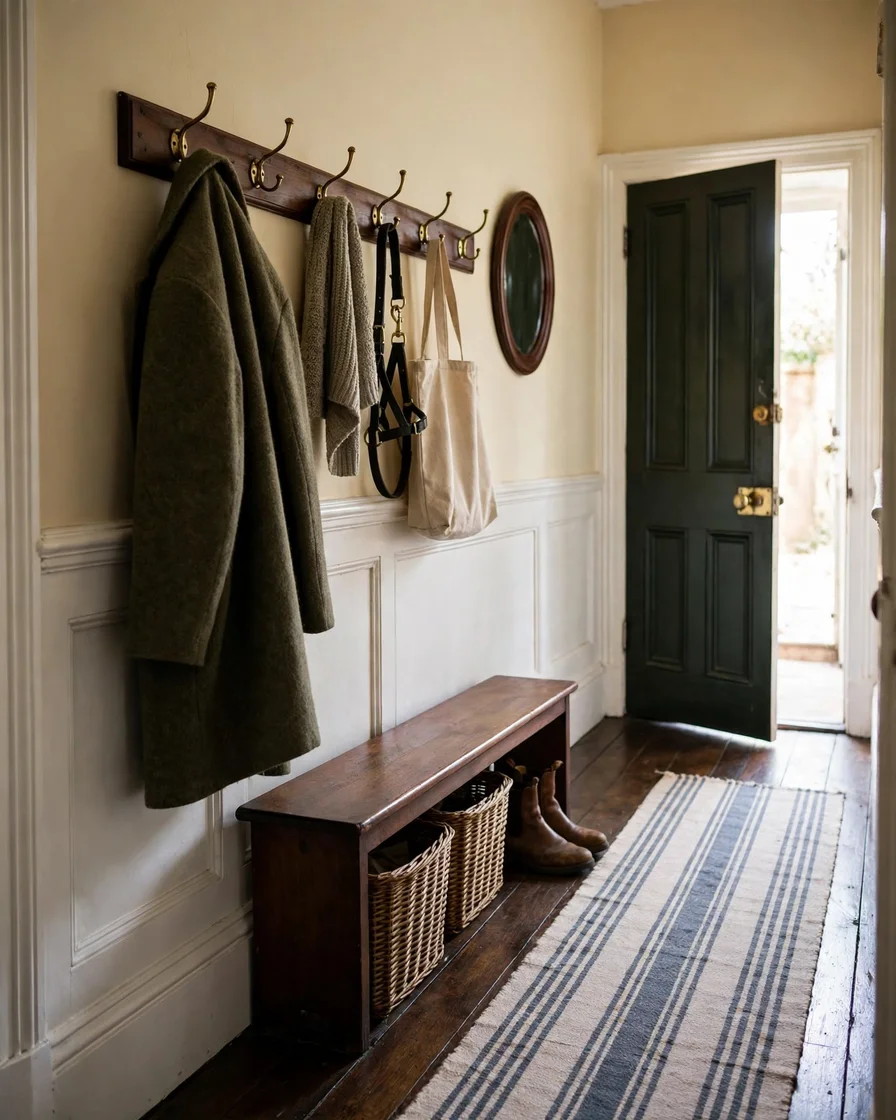
Coats piled on a chair make a narrow hall feel smaller, so give them a rail and a bench that hug the wall. In the photo, a dark wood rail with brass hooks holds a green wool coat, a beige scarf, a dog lead, and a canvas tote, with a round wooden-framed mirror beside it. Below, a narrow wooden bench holds two wicker baskets and a pair of brown boots underneath, and a striped cream and blue runner runs along the dark wood floor toward a dark green door. Fix the rail into the wall studs at about shoulder height, spacing the hooks wide enough that coats do not bunch. Slide the bench underneath, leaving enough room to sit and pull boots on. Tuck a basket under the bench for each person in the house. Fitting the rail and bench takes about an hour. For a budget-friendly version, use a secondhand bench and a rail of salvaged hooks, and swap the baskets for bags you already own.
Quick Tip: Hang one hook per person plus one spare, so guests never end up draping coats over the bench.
8. Look Up: Give the Ceiling Rose and Cornice Their Due
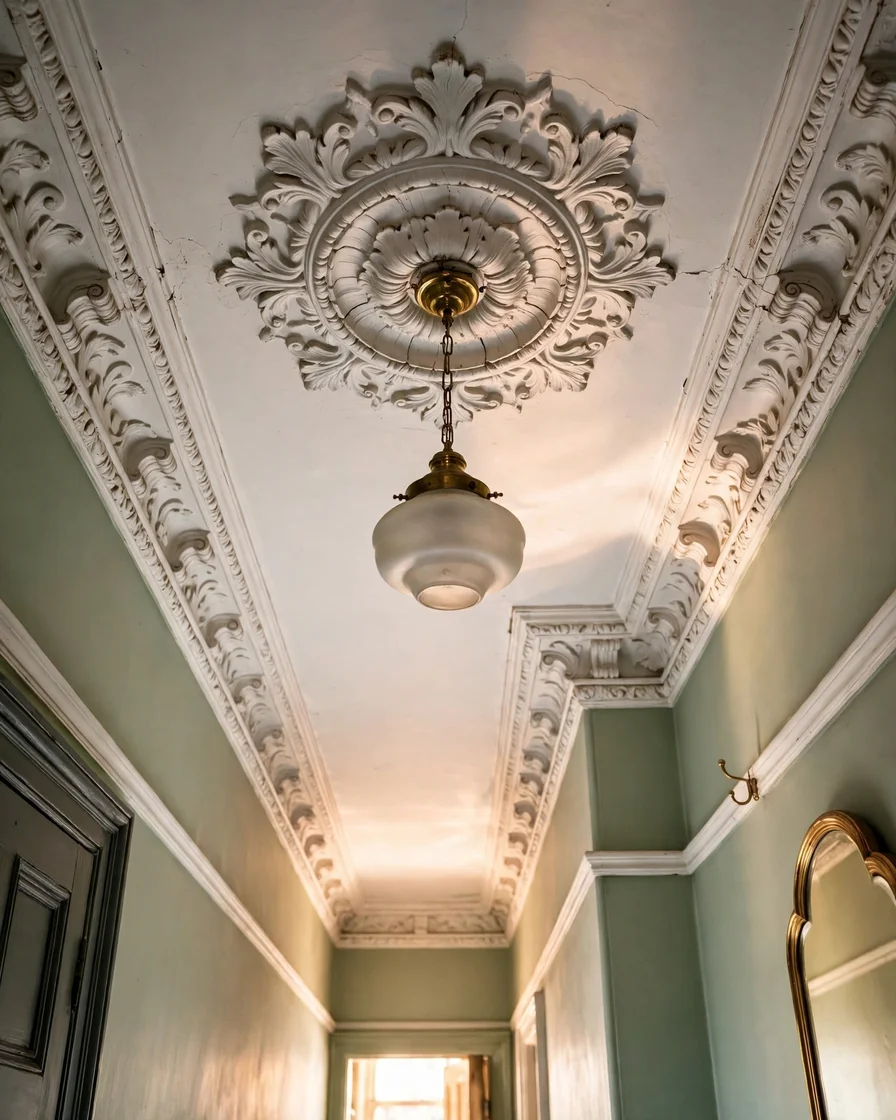
Most people decorate a hall from the floor up and never look at the ceiling, which is where the best Victorian detail lives. In the photo, an ornate white plaster ceiling rose with curling leaves holds a brass pendant with a frosted glass shade, and deep carved cornice runs along both sides of the ceiling. Sage-green walls, a white picture rail, the edge of an arched gold mirror, and a small brass picture hook complete the view. Start by brushing dust out of the plasterwork with a soft brush, then paint the ceiling a clean white so the rose and cornice stand out. Hang a pendant that suits the scale of the rose, dropping it low enough to light the hall without blocking the view down it. Cleaning and painting takes an afternoon. For a budget-friendly version, skip new plaster and spend the effort on paint and a secondhand pendant that fits the rose.
Quick Tip: Paint the cornice the same white as the ceiling so the plasterwork reads as one piece.
9. Run a Stair Runner Up the Hall Stairs
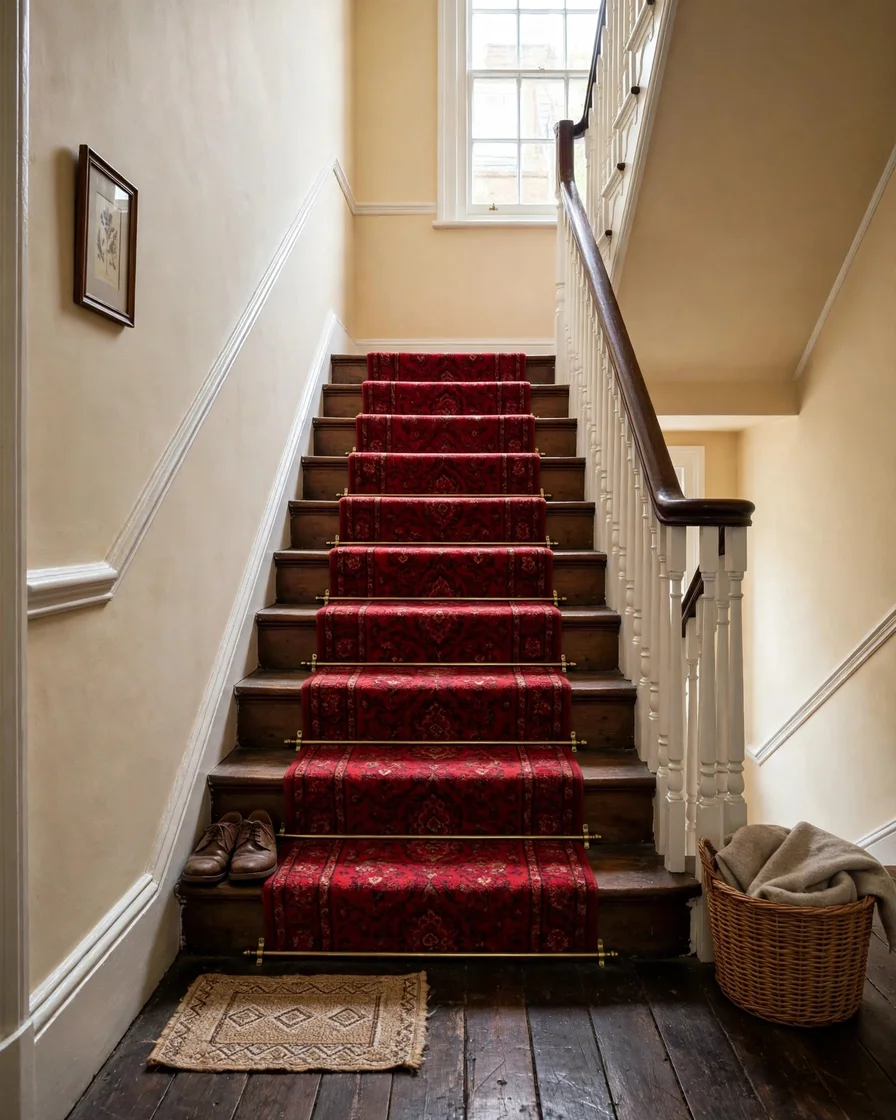
The stairs are the biggest surface in a hall with a staircase, so a runner there changes the whole room. In the photo, a deep red patterned runner climbs wooden stairs held in place by brass stair rods, with white painted spindles and a dark wood handrail on one side and a cream wall with a framed botanical print on the other. Brown shoes rest on the bottom step, a wicker basket with a folded blanket sits by the newel post, and daylight falls down the stairwell from a landing window. Measure each step and the total run before you order, then lay underlay on the treads and fit the runner from the top step down, pulling it tight at each riser. Fix a brass rod at the back of every tread. Fitting a runner takes a day, with help for the measuring. For a budget-friendly version, use an offcut runner and fit rods on alternate steps, or skip the rods and fix the runner with gripper strips.
Quick Tip: Choose a runner with a small repeat pattern so the design lines up neatly on every step.
10. Paint the Panelled Doors Deep and Polish the Brass
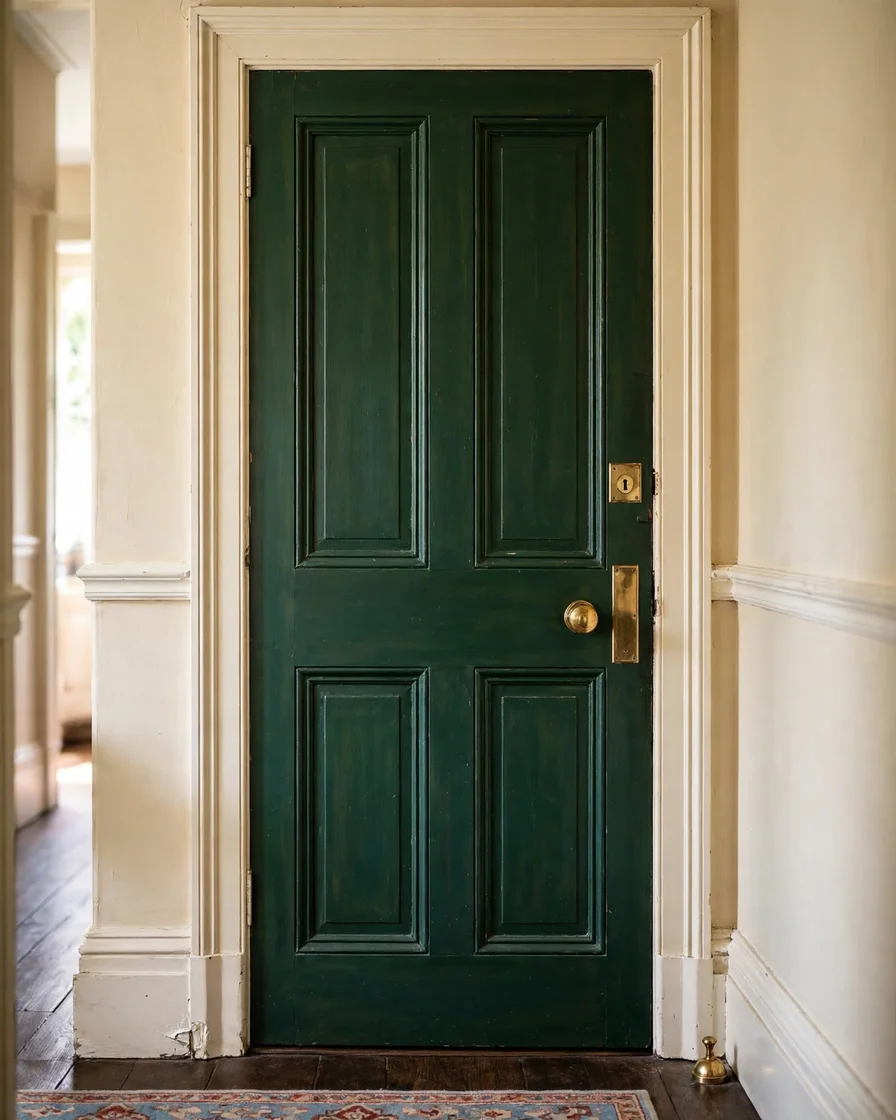
A dark door in a pale hall acts like a full stop at the end of a sentence, giving the long corridor a place to rest the eye. In the photo, a four-panel door painted deep forest green stands in a cream-painted frame, with a polished brass doorknob, a long brass finger plate, and a brass escutcheon, a white dado rail running along the cream wall beside it, and the edge of a patterned runner on the dark wood floor. Take the door off its hinges and lay it flat, then remove the brass hardware and sand the panels smooth. Prime the bare wood, roll on two coats of deep green, and let each coat dry fully before the next. Polish the brass while the paint dries and refit it last. One door takes a day from start to finish. For a budget-friendly version, paint one door first and live with it for a week before deciding whether to paint the rest.
Quick Tip: Paint the door edges the same deep color so no pale line shows when the door stands open.
11. Lean a Tall Mirror at the End of a Narrow Victorian Hallway
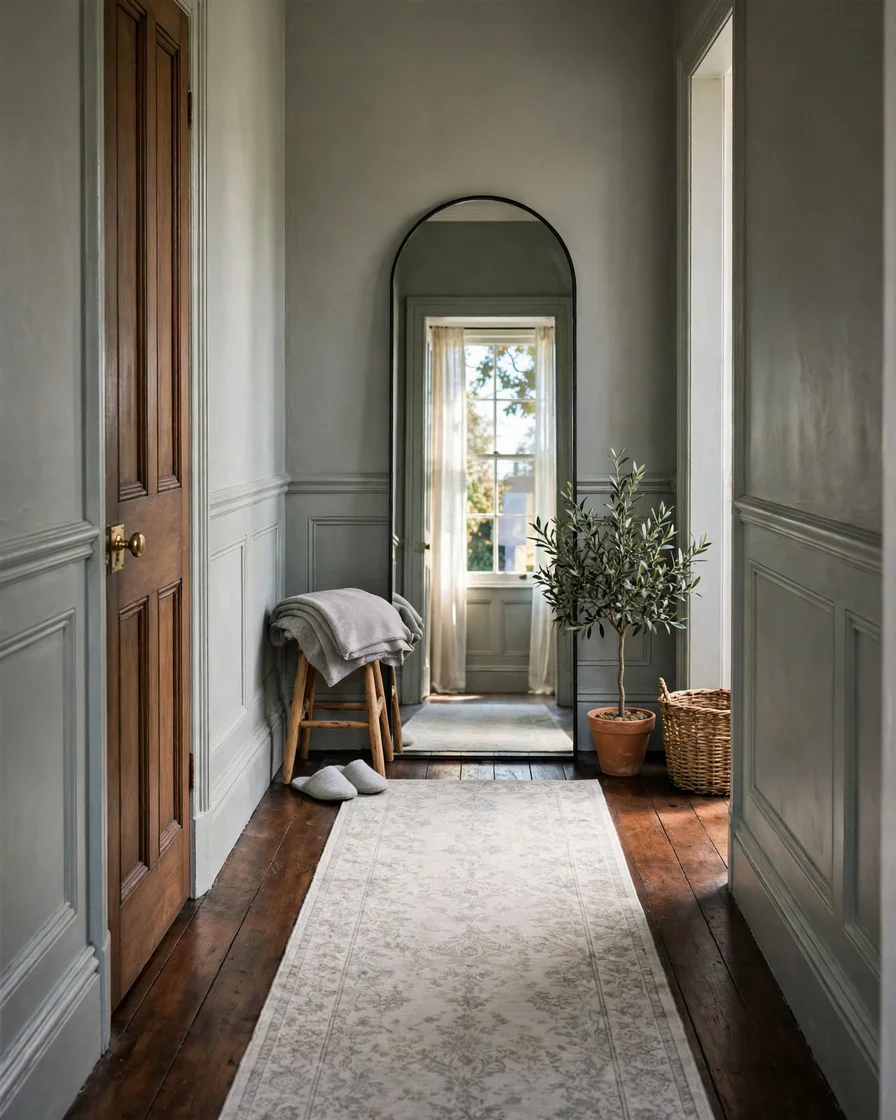
A tall mirror at the far end of the hall doubles the light and makes the corridor feel twice as long in the best way. In the photo, a tall arched mirror with a thin black frame leans against the end wall, reflecting a bright window with sheer curtains, while a potted olive tree in a terracotta pot stands beside it and a wooden stool with a folded grey throw sits on the other side. Grey slippers rest on the dark wood floor, a woven basket waits by the tree, and a pale patterned runner leads the eye straight to the mirror. Pick the end of the hall that faces the brightest window, then lean the mirror against the wall and anchor the top to the wall so it cannot slip. Set the plant beside it and keep the floor in front clear. The whole setup takes about thirty minutes. For a budget-friendly version, look for a secondhand full-length mirror and lean it as it is, since the frame matters less than the reflection.
Quick Tip: Angle the mirror a fraction toward the nearest window so it catches the most daylight.
12. Borrow Daylight With a Glazed Internal Door
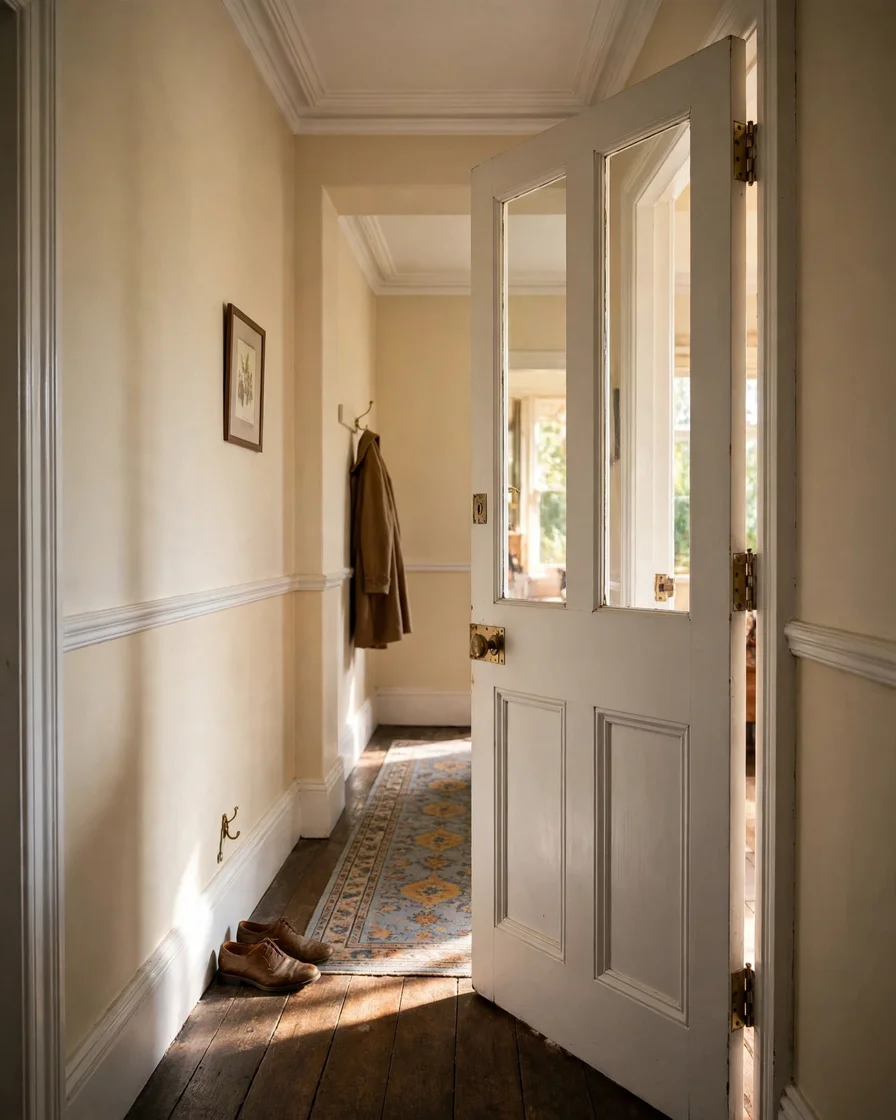
A solid door between the hall and a bright room shuts the light out, so swap it for glass and let the daylight in. In the photo, a white four-panel door with two tall glazed upper panels stands open, spilling warm daylight from the room beyond across the dark wood floor and a blue and gold patterned runner. Cream walls, a white dado rail, a framed botanical print, a brown coat on a brass hook, and a pair of brown shoes by the skirting board complete the scene. Measure your existing door first, since Victorian doorways rarely match modern sizes, then either swap in a glazed door or have a joiner replace the top two panels of your door with glass. Use clear glass where privacy does not matter and frosted film where it does. Hanging a new door takes half a day. For a budget-friendly version, fit frosted film to a plain glazed door you already own, or hunt for a secondhand glazed door in a salvage yard.
Quick Tip: Leave the glazed door open during the day and close it at night, so the hall borrows light when it needs it most.
Expert Tips
- Keep the walkway clear: measure your hall and leave at least 90 centimeters of clear floor between furniture and the opposite wall, or the hall will feel like an obstacle course.
- Use the picture rail: Victorian halls were built with one, so hang prints from it with cord and hooks instead of drilling into old plaster.
- Match your metals: pick one finish, brass or black iron, and use it for every hook, light, and knob so the long hall reads as one room.
- Test paint in hallway light: colors look darker in a corridor than on a shop card, so paint a large test patch and check it morning and evening.
- Start at the front door and work inward: the first three feet set the tone for the whole hall, so finish the entrance before you move deeper.
Final Thoughts
Start with the pale paint, the tall mirror at the end of the hall, or the coat rail above a slim bench — each one takes an afternoon or less and changes the hall the moment it is done. Pick one end of the hall this weekend, and let the next idea wait until the first one feels finished.
How do you make a narrow Victorian hallway look wider?
Paint the walls a warm off-white, keep the floor clear, and lean a tall mirror at the far end to stretch the view. A pale runner laid lengthwise pulls the eye down the hall instead of across it, and slim furniture that hugs one wall leaves the walkway open. Avoid dark paint on both walls, since it closes the corridor.
What color paint works best in a dark Victorian hallway?
Warm off-whites, pale grey-greens, and soft stone shades work best, because they bounce the little light the hall gets. Paint the ceiling white and keep the woodwork a shade lighter than the walls so the dado rail and skirting boards catch the light. Save deep colors for one door or the panelling below the dado.
Can you hang things on Victorian plaster walls?
Yes, as long as you fix into the studs or use the picture rail instead of drilling straight into old plaster. Heavy mirrors and coat rails need screws in solid timber, while light prints can hang from the picture rail with cord and hooks. Test one fixing in a hidden spot first to see how the plaster holds.
How do you light a hallway with no windows?
Layer three sources: a pendant from the ceiling rose, wall lights at eye level, and a lamp at the far end. Stagger the wall lights on opposite walls so their pools of light overlap, and use the same warm bulb color throughout so the hall glows evenly. A mirror opposite the brightest light doubles what you have.
What is the best flooring for a narrow Victorian hallway?
Original encaustic tiles are the best flooring if you have them, since they were made for the space and last for decades. Clean and seal them, then lay a long runner down the middle to soften the sound and protect the pattern. If the tiles are gone, dark wood boards with a runner give a similar period feel.