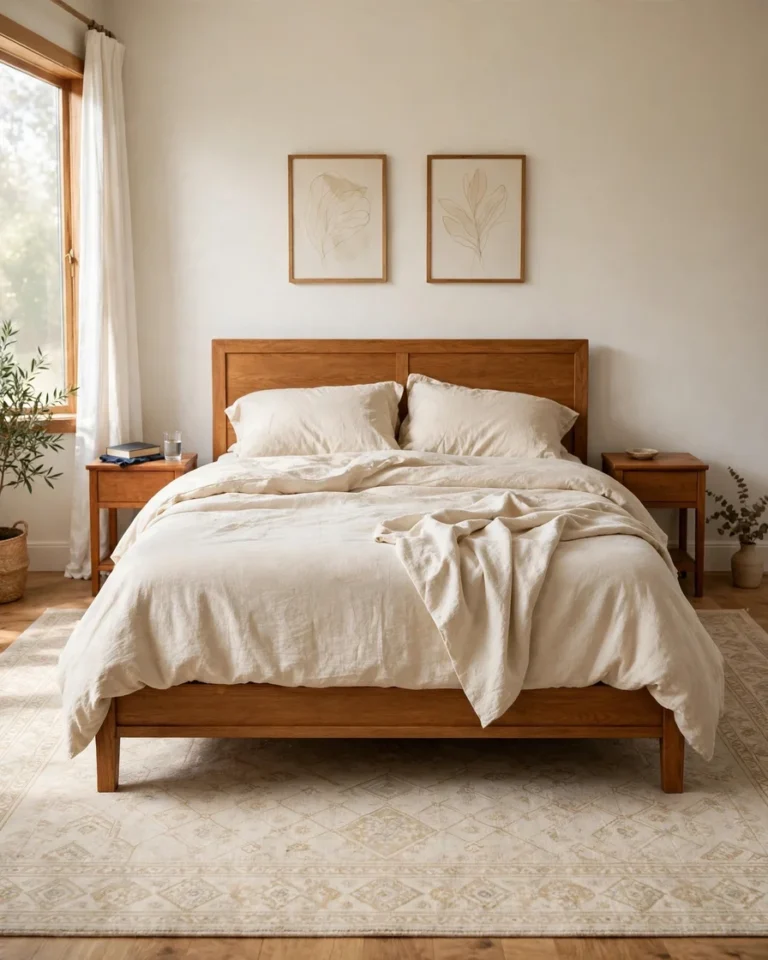
Small bedroom apartment ideas start from a real problem: a bed that eats half the floor, a closet that barely holds one season of clothes, and a nightstand buried under everything with nowhere else to go. A tiny bedroom isn’t a design failure — it’s a space problem, and space problems have practical answers.
Across these 15 ideas you’ll find storage beds, wall-mounted desks, loft layouts, and renter-friendly tricks that need no drilling at all. Each one is built for a real apartment — a small room, thin walls, and a landlord who notices holes. Pick the fix that matches your biggest headache, and start there.
1. Small Bedroom Apartment Ideas: Start With a Storage Bed
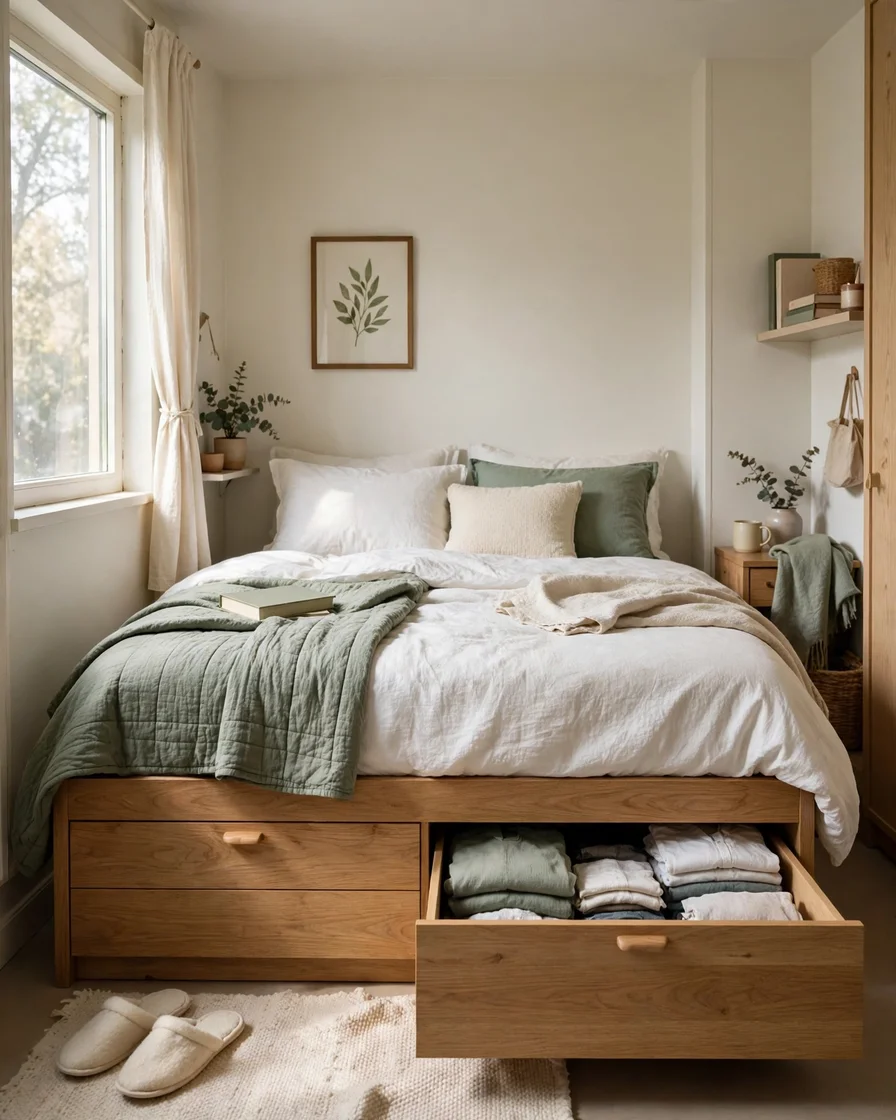
A storage bed is the highest-impact swap a small bedroom can get, because it turns the biggest piece of furniture into the biggest closet. In the photo, a light oak platform bed hides deep drawers under the mattress, and one drawer sits open showing neatly folded clothes stacked inside — the kind of storage that would otherwise need a whole dresser. Start by measuring the space around your bed, since the drawers need about two feet of clear floor to slide out. Move the heaviest things you own into them: out-of-season clothes, spare bedding, and bulky sweaters. Keep everyday items in the drawer nearest the door. Assembly takes most of an afternoon, and you’ll want a second person to lift the frame into place. For a cheaper route, watch local marketplaces for a secondhand storage frame, or start with bed risers and low bins under your current frame while you save up.
Quick Tip: Label each drawer with a small tag on the inside edge so you always know where the winter sweaters live.
2. Hang Floating Shelves Above the Headboard
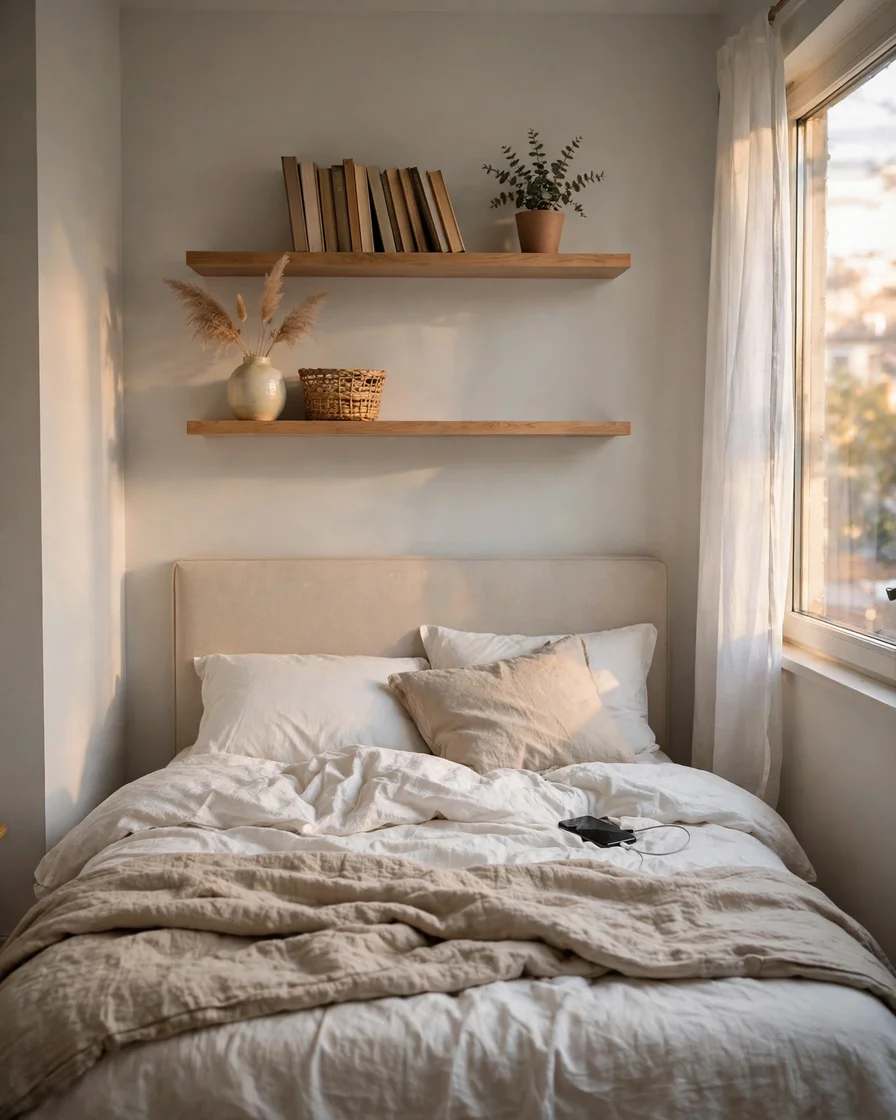
The wall above your headboard is the most wasted space in a small bedroom, and two floating shelves turn it into a whole extra surface. In the photo, two light wood shelves sit above a beige upholstered headboard, holding a row of books, a small potted plant, a ceramic vase with dried grasses, and a woven basket — all of it off the floor and out of the way. Find the studs with a stud finder first, since shelves loaded with books need real support, then mount the lower shelf about 18 inches above the headboard so you won’t bump your head sitting up. Put nightly essentials on the lower shelf and the prettier, lighter pieces up top. The whole job takes about an hour with a drill and a level. For a cheaper route, use one long shelf instead of two, or pick up secondhand brackets and a board cut to size at the hardware store.
Quick Tip: Keep the shelves shallow — 8 to 10 inches deep — so nothing hangs over the pillows.
3. Push the Bed Into the Corner
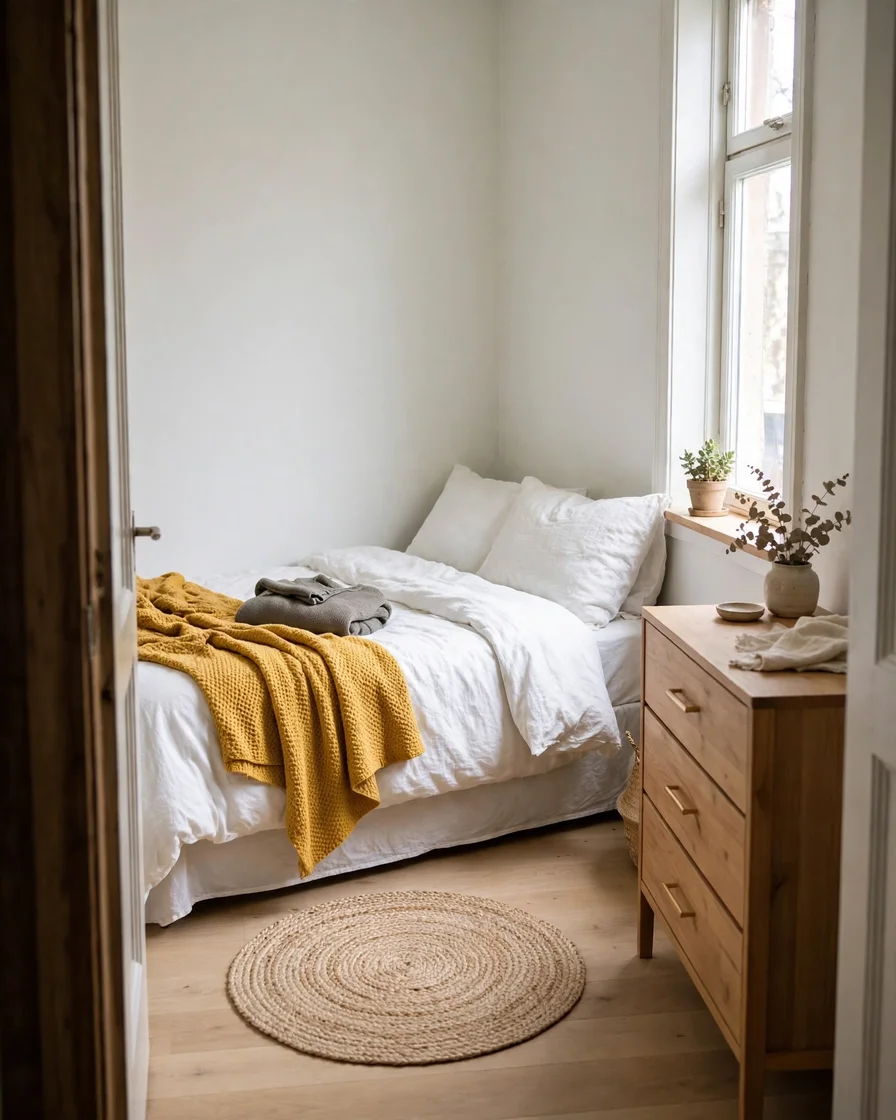
Centering the bed wastes a walkway on each side — space you never really use in a tiny room. In the photo, a double bed sits tight into the corner against two pale walls, a mustard throw folded across white bedding, and the middle of the room stays open with a round jute rug and a slim wooden dresser on the opposite wall. Slide the bed into the corner that leaves the door and the closet clear. Sleep on the open side so getting in and out stays easy, and tuck a small basket in the far corner for the things that used to live on a nightstand. The move takes 20 minutes and a friend to lift the frame. For a cheaper route, this one is free — you’re just rearranging — and a thrifted rug in the freed-up floor space finishes the look. If you want more layout inspiration, these small apartment bedroom ideas show how other tiny rooms squeeze in a full setup.
Quick Tip: Leave a two-inch gap between the mattress and the wall so air can circulate and the bedding stays fresh.
4. Mount a Fold-Down Wall Desk
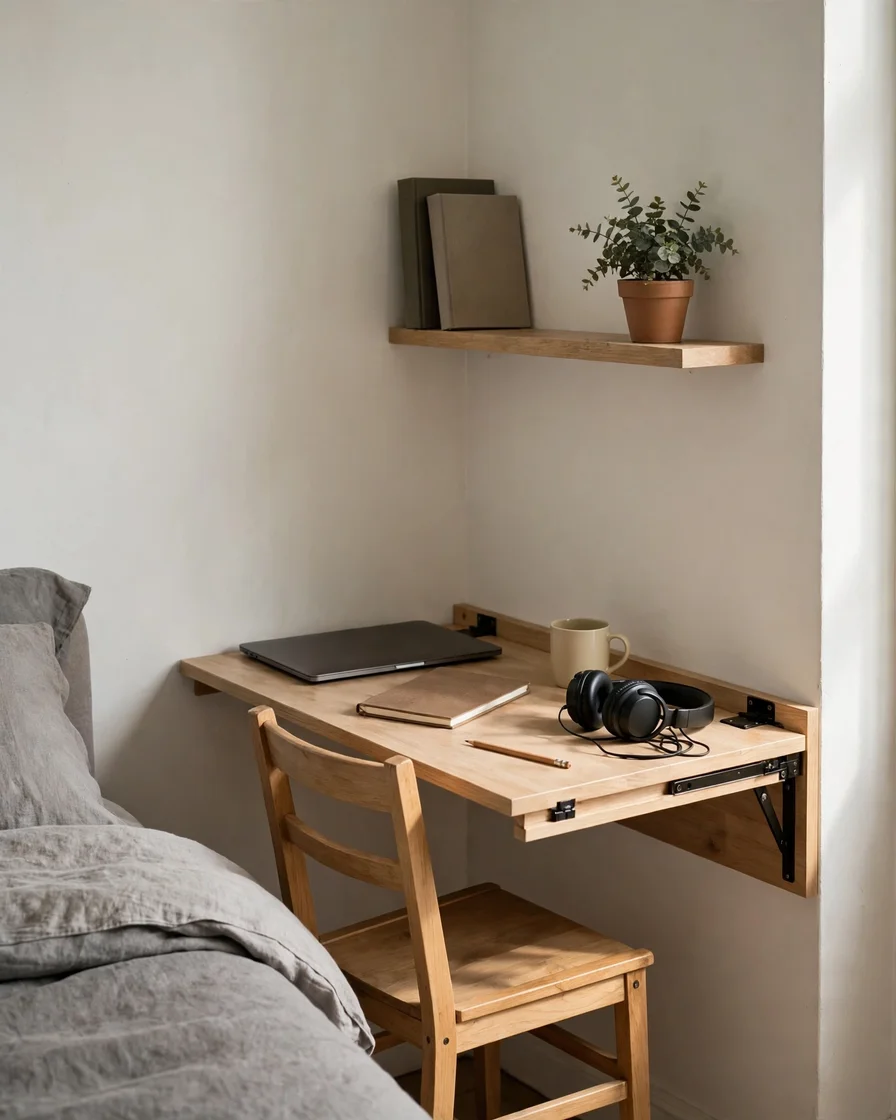
A fold-down wall desk gives you a real workspace that disappears the moment you’re done with it. In the photo, a light wood desk panel folds down from the wall beside the bed, holding a closed laptop, a notebook, a mug, and a pair of headphones, with a small shelf above it for books and a plant and a simple wooden chair tucked in. Choose a wall near an outlet, then mount the desk at standard desk height — about 30 inches — using wall anchors or studs so it holds steady under a laptop. Fold it up at night and the room goes back to being a bedroom. The install takes about two hours, and the chair slides under the bed when the desk is folded away. For a cheaper route, a sturdy shelf bracket and a board from the hardware store work the same way, and a thrifted folding chair keeps the setup light.
Quick Tip: Stick a small adhesive cable clip under the desk edge so your charger is always within reach.
5. Small Bedroom Apartment Ideas: Go Up With a Loft Bed
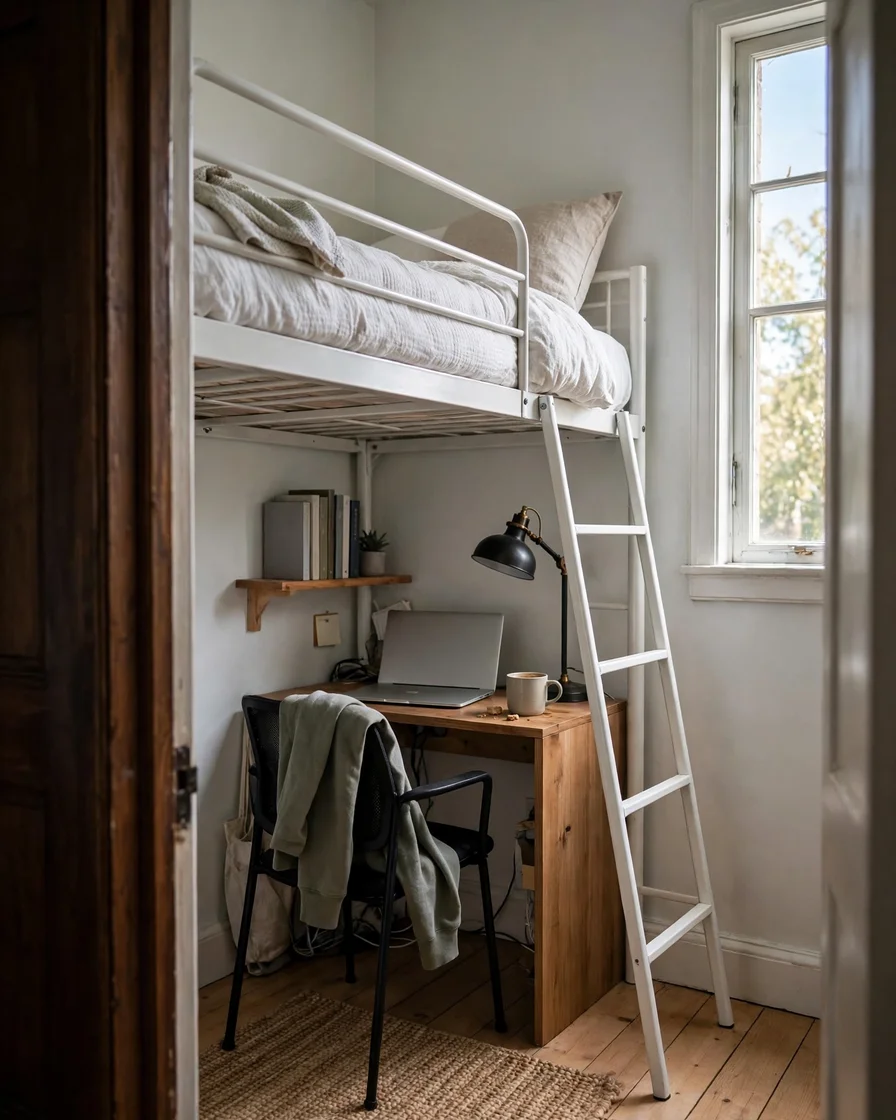
A loft bed is the boldest move on this list, and in a truly tiny room it doubles your floor space overnight. In the photo, a white metal loft bed stands high against the wall with a ladder on the side, and underneath it sits a compact wooden desk with a laptop, a black desk lamp, and a chair with a hoodie draped over it — a full workspace in the footprint the bed used to waste. Measure your ceiling height first: you need at least 8 feet so you can sit up in bed without hitting your head. Assemble the frame first, anchor it to the wall for stability, then slide the desk underneath and hang a small shelf for books. The build takes a full afternoon with two people. For a cheaper route, look for a secondhand metal loft frame and use a desk and chair you already own underneath.
Quick Tip: Clip a small reading light to the loft rail so you don’t have to climb down to switch off the lamp.
6. Slide Rolling Bins Under the Bed
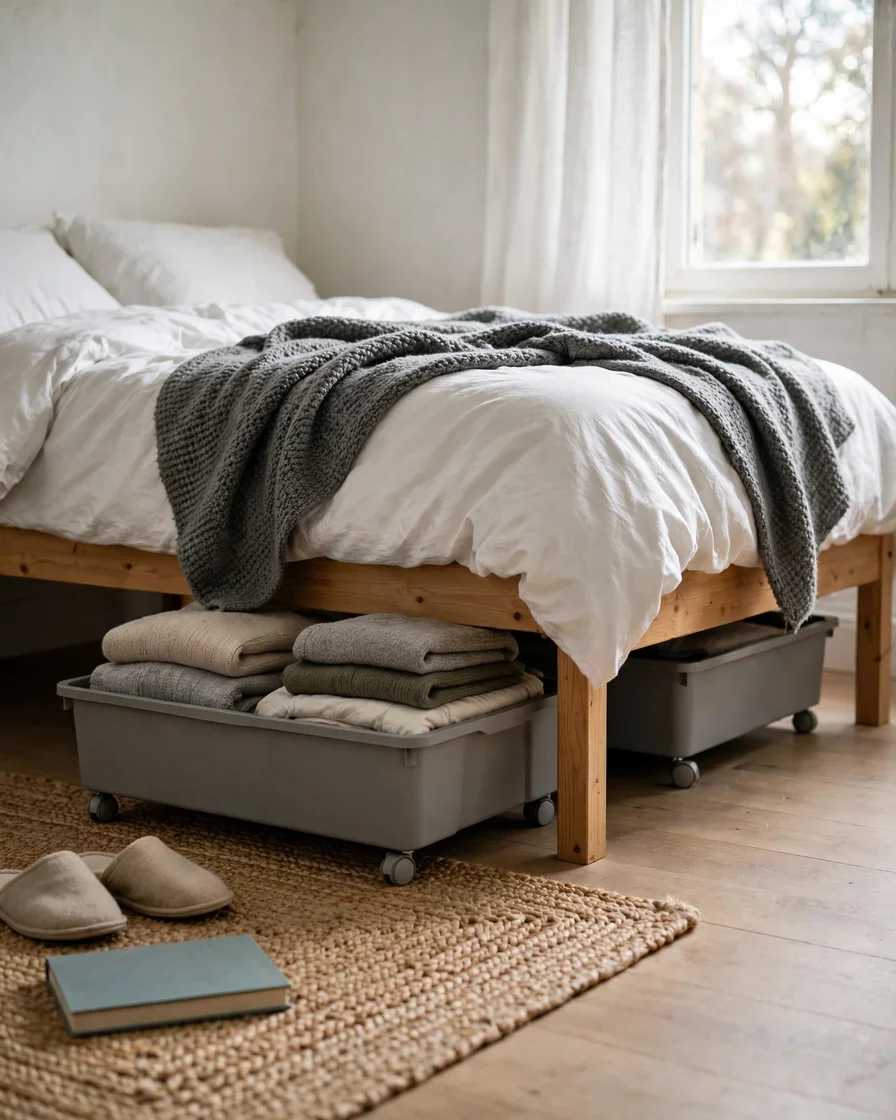
The space under the bed is often the biggest storage area in a small bedroom, and rolling bins make it usable instead of dusty and forgotten. In the photo, two low grey bins on casters sit under a simple wooden bed frame, one pulled halfway out to show neatly folded sweaters and spare bedding stacked inside, with slippers and a book resting on the rug nearby. Start by measuring the clearance under your frame — most bins need 6 to 7 inches — then sort what goes in: out-of-season clothes in one bin, spare sheets in the other. The casters matter, because a bin you have to drag will stay buried. Setup takes about 30 minutes including the sorting. For a cheaper route, repurpose shallow boxes you already own and add stick-on furniture sliders to the bottom, or watch for clear bins on sale and label them with masking tape.
Quick Tip: Keep a short list taped inside the wardrobe door of what’s in each bin so you never open the wrong one.
7. Lean a Full-Length Mirror Against the Wall
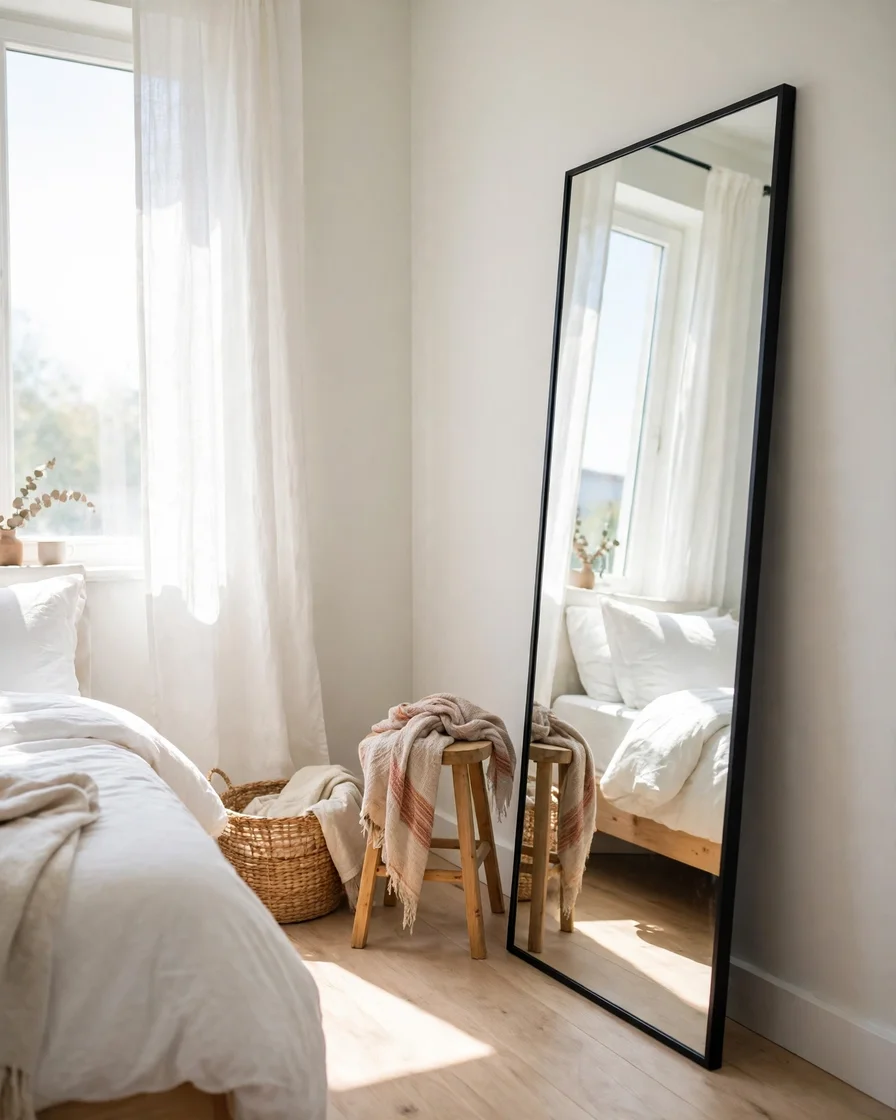
A full-length mirror makes a small bedroom feel bigger fast, because it bounces light and doubles the view. In the photo, a tall mirror in a thin black frame leans against a pale wall opposite a bright window, reflecting the daylight and a glimpse of the bed with white bedding, with a small wooden stool and a woven basket beside it. Pick the wall opposite or beside your window — that’s where the mirror catches the most light — then lean it at a slight angle and secure the top with a small adhesive hook or a furniture strap so it can’t slide. No drilling, no damage, and setup takes 15 minutes. For a cheaper route, thrift stores are full of tall mirrors in plain frames, and a coat of matte black spray paint makes any of them look new. If you want more tricks for opening up a tight room, these small bedroom ideas cover mirrors, light, and layout together.
Quick Tip: Angle the mirror slightly toward the window, not straight ahead, so it reflects light instead of the opposite wall.
8. Swap the Nightstand for a Floating Shelf
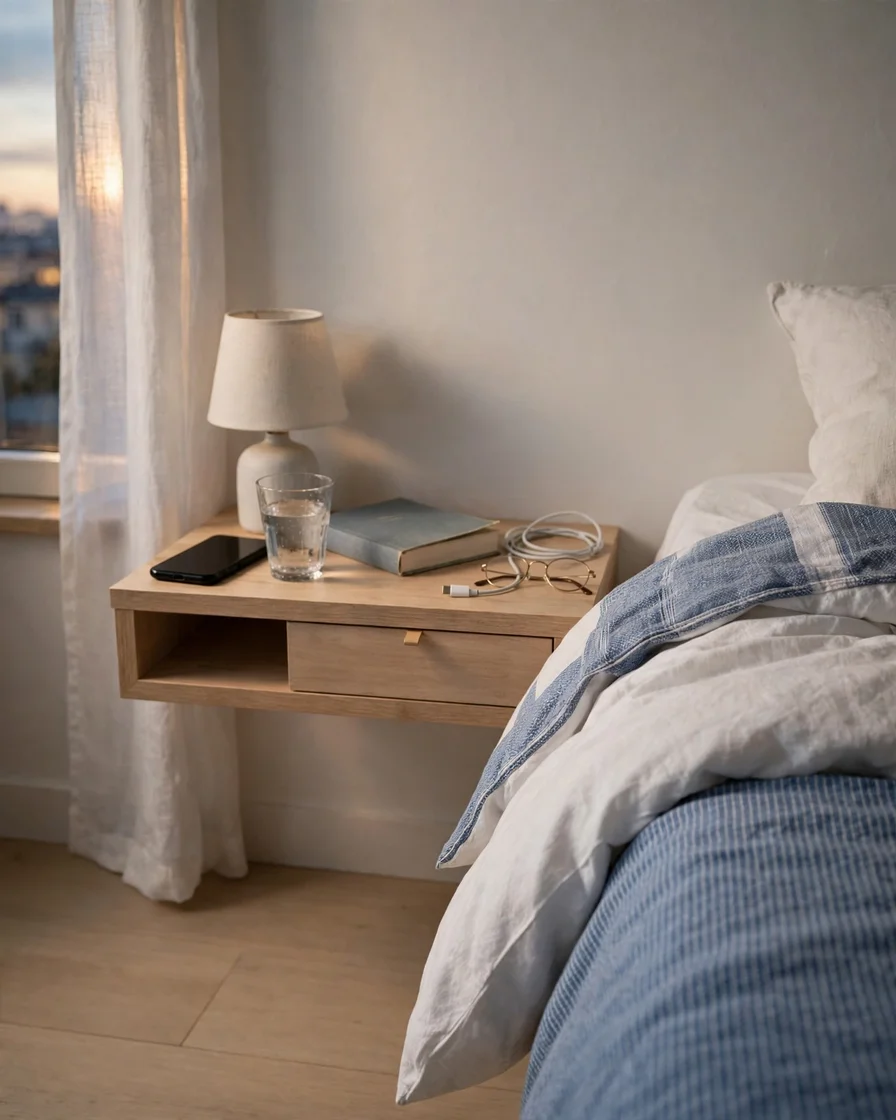
A traditional nightstand eats a square foot of floor you don’t have, while a floating shelf does the same job on the wall. In the photo, a compact light wood shelf with a small drawer mounts beside a bed dressed in blue and white bedding, holding a lamp, a phone, a glass of water, a paperback, and a pair of reading glasses, with the floor clear underneath. Start by mounting the shelf at mattress height so you can reach your phone and water without sitting up, using wall anchors rated for the weight. The drawer swallows the small stuff — chargers, lip balm, earplugs — that used to clutter the surface. Install takes under an hour with a drill and a level. For a cheaper route, a single floating shelf from a discount store works fine, and a small basket underneath holds the rest. The open floor below also makes the room easier to sweep.
Quick Tip: Run the charging cable through a small hole in the back corner of the shelf so it never dangles.
9. Put a Pegboard on the Wall
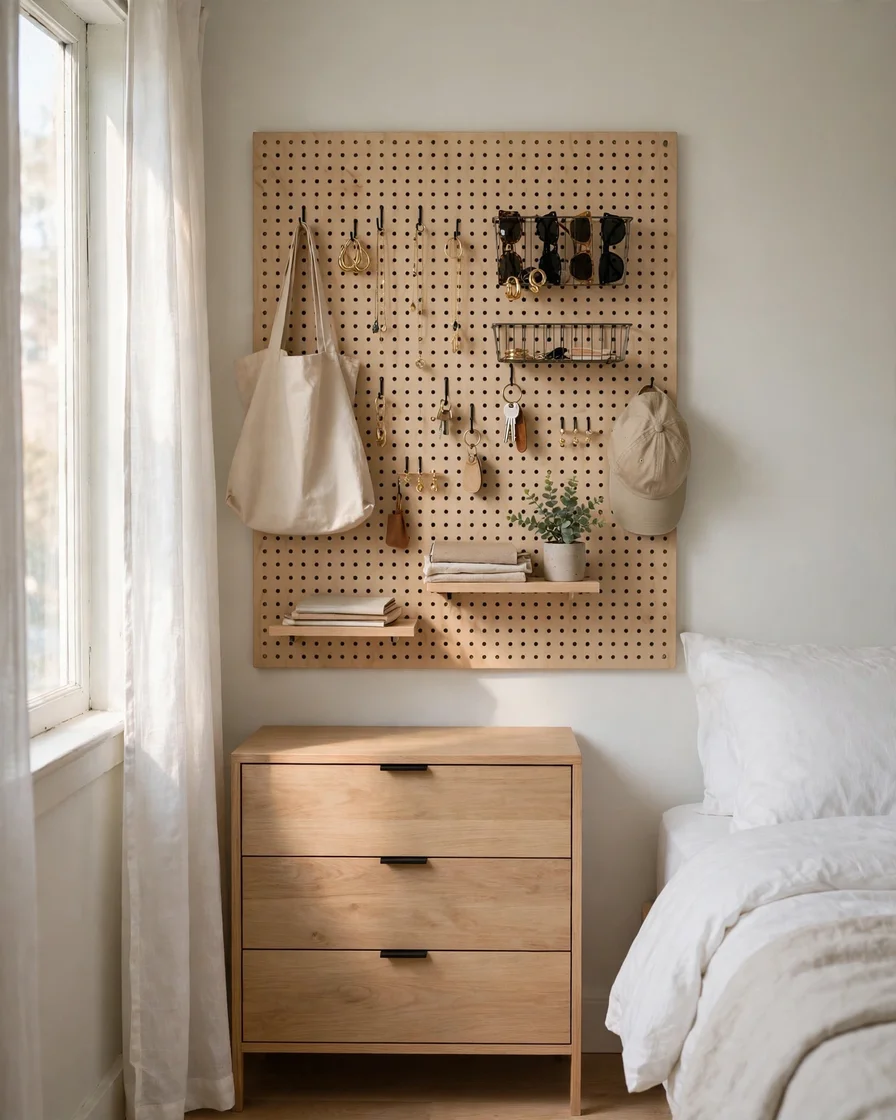
A pegboard turns a blank wall into a flexible organizer that changes as your stuff changes. In the photo, a large light wood pegboard hangs above a wooden dresser beside the bed, fitted with hooks, wire baskets, and small shelves holding jewelry, sunglasses, a cap, keys, a tote bag, a small plant, and a stack of notebooks. Start by choosing a wall you pass every day, then mount the board with spacers behind it so the hooks have room to seat properly. Hang the things you grab daily at eye level and the prettier pieces higher up. The whole setup takes about an hour, and rearranging it later takes seconds — just move the hooks. For a cheaper route, a small pegboard panel from the hardware store costs little, and you can paint it to match the room with a sample pot of paint. It also works over a desk or beside the door.
Quick Tip: Outline each item’s spot with a pencil dot on the board so everything has a home and clutter stays visible.
10. Use a Storage Ottoman at the Foot of the Bed
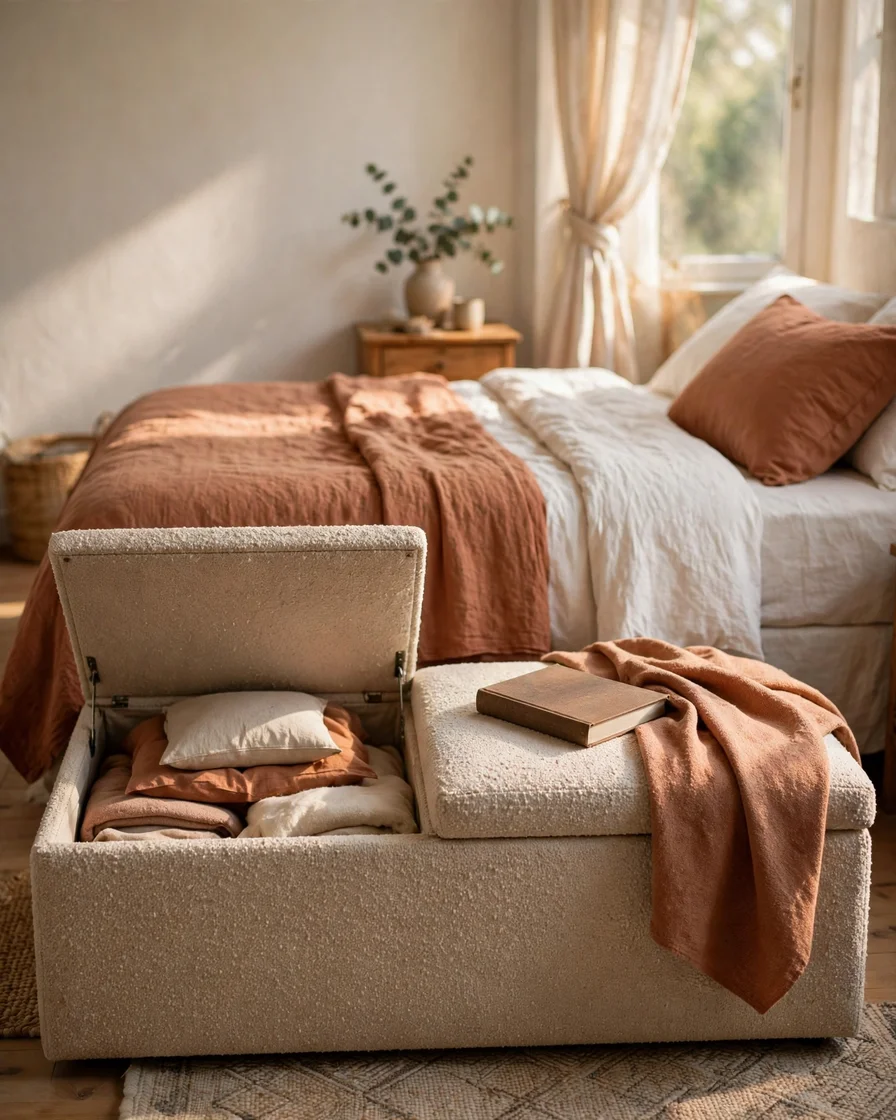
A storage ottoman does three jobs at once: a seat, a footrest, and a hidden closet for the soft stuff. In the photo, a long ottoman in oatmeal boucle fabric sits at the foot of a bed with terracotta bedding, one lid open to show spare pillows and folded blankets inside, while the closed half holds a book and a draped throw. Measure the width of your bed — the ottoman should be about two-thirds as wide — then place it a few inches from the footboard so you can still walk past it. Fill it with the bulky soft things that never fit anywhere: spare pillows, throws, and winter blankets. Setup is just unboxing and placing it, about 10 minutes. Choose a firm lid if you plan to sit on it often, since a soft one sags under weight. For a cheaper route, look for a secondhand ottoman and recover the lid with a remnant of fabric, or use a lidded trunk you already own.
Quick Tip: Keep only soft things inside — hard objects make the lid heavy and the seat uncomfortable.
11. Hang an Over-the-Door Organizer
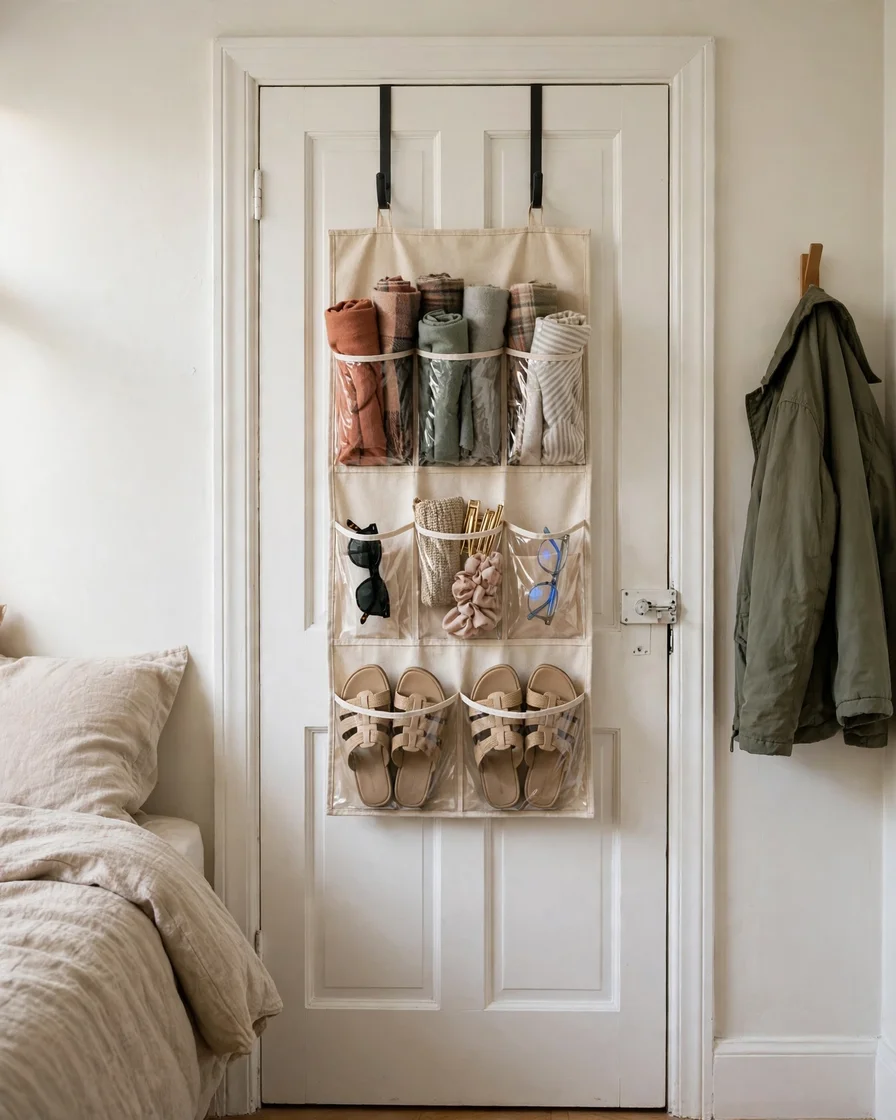
The back of the bedroom door is storage space most people never think about, and an over-the-door organizer claims it in minutes. In the photo, a canvas organizer hangs from two hooks over a white door, its clear pockets holding rolled scarves, sunglasses, small accessories, and a pair of sandals, with a jacket hanging on a hook beside it. Start by checking the gap above your door — most organizers need about half an inch — then hang the hooks, fill the top pockets with the things you use least, and keep daily items at hand height. Sorting and hanging takes about 20 minutes, and nothing gets drilled or damaged, which landlords appreciate. For a cheaper route, a shoe organizer from a discount store does the same job, and clear pockets beat fabric ones because you can see everything at a glance. It also works on a closet door or the bathroom door.
Quick Tip: Roll scarves and belts instead of folding them — they slide out of the pockets without tangling.
12. Split the Room With a Curtain Divider
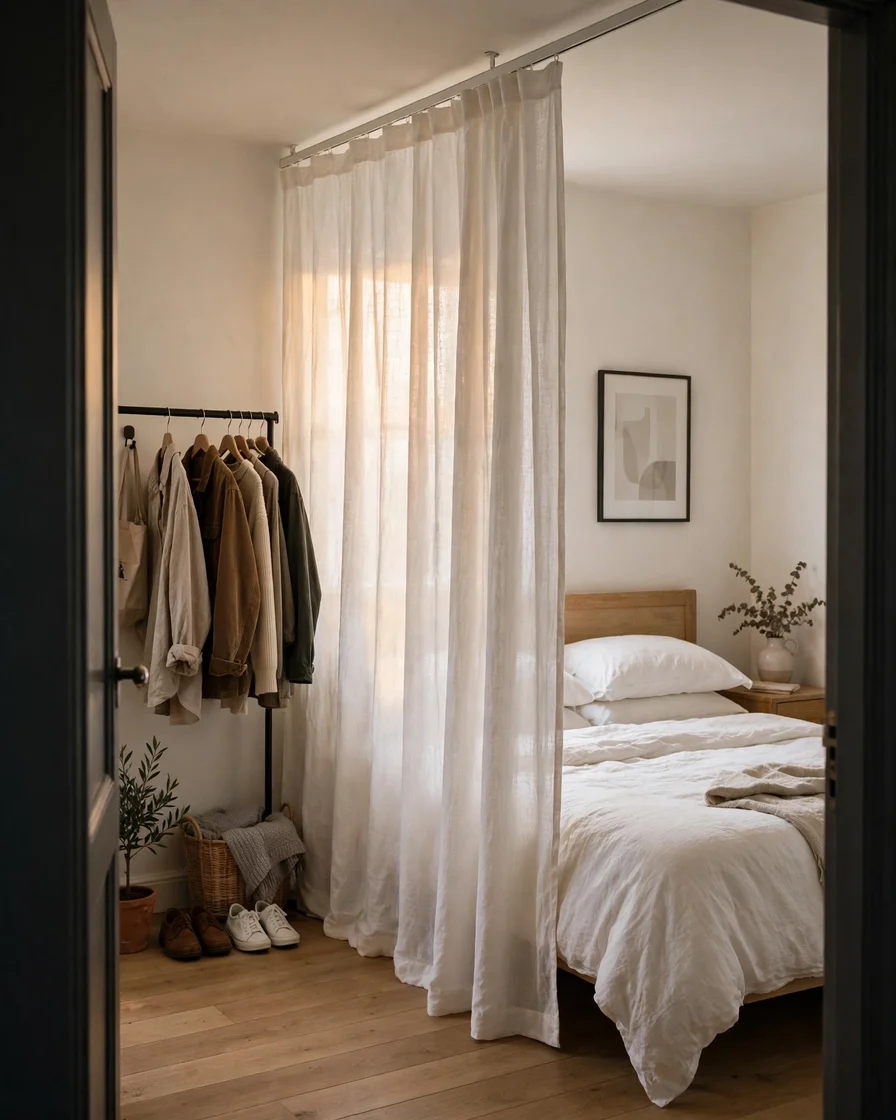
When one small room has to be a bedroom and a dressing area, a curtain divider gives you both without a single wall. In the photo, a ceiling-mounted track holds soft white linen curtains drawn halfway across the room, with the bed and white bedding on one side and a clothing rail with hanging jackets on the other, shoes and a basket tucked below the rail. Start by measuring the line where you want the split, then mount a ceiling track or a tension rod between two walls — tension rods need no drilling at all. Hang curtains that reach the floor so the divide feels solid, and pick a light fabric so daylight still passes through. The install takes about an hour, and you can take the whole thing down in minutes when you move out. For a cheaper route, use a tension shower rod and flat bedsheets clipped on with ring clips, which cost little and wash easily.
Quick Tip: Leave a gap of a few inches at one end so you can slip through without pushing the whole curtain aside.
13. Squeeze a Slim Rolling Cart Into the Gap
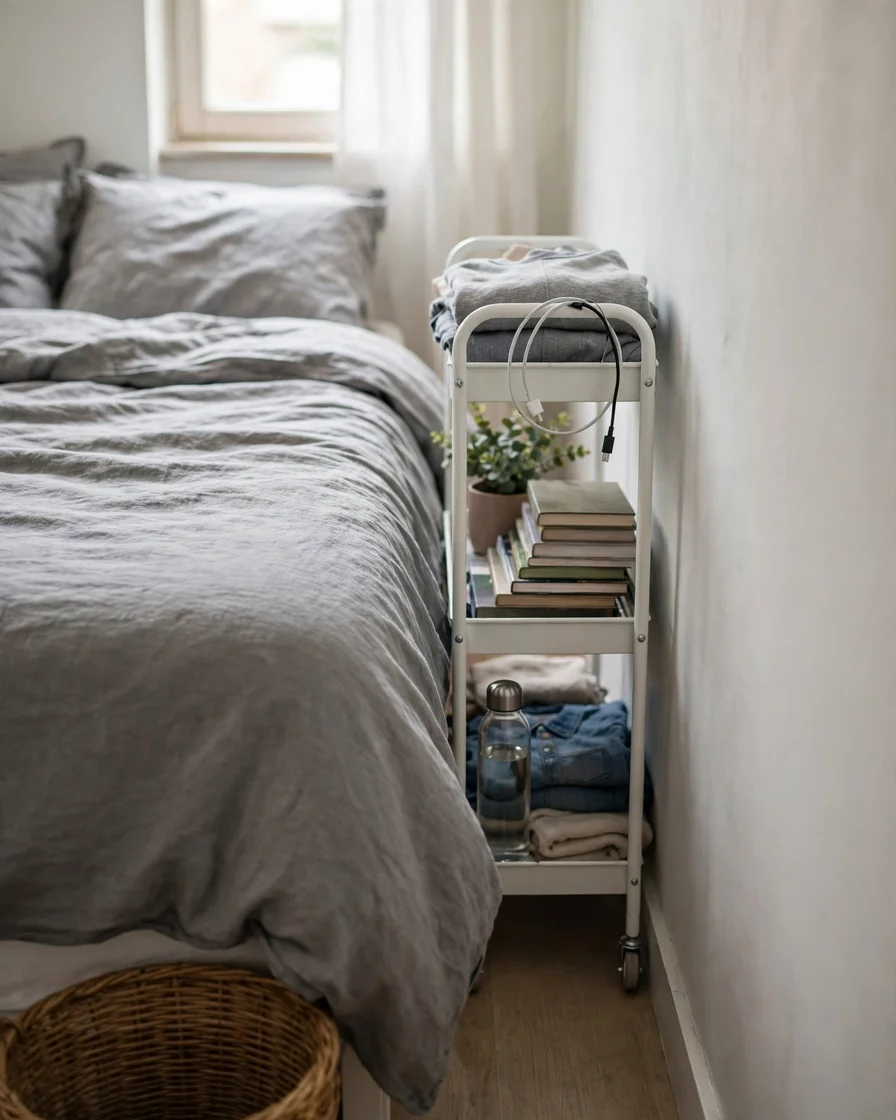
Every small bedroom has a gap — between the bed and the wall, or beside the dresser — that’s too narrow for furniture but perfect for a slim rolling cart. In the photo, a white three-tier cart on small casters slots into the gap beside a bed with grey bedding, its tiers holding folded clothes, a stack of books, a small plant, a water bottle, and a charger cable draped over the top rail. Measure the gap first — most slim carts are about 6 inches wide — then load the top tier with the things you reach for most and the bottom tier with heavier items so it stays stable. Assembly takes about 20 minutes, and the cart rolls out for cleaning. Keep the casters locked when the cart is parked so it never drifts across the floor at night. For a cheaper route, a secondhand kitchen cart works the same way, and a coat of spray paint makes it match the room.
Quick Tip: Put the heaviest items on the bottom tier so the cart never tips when you pull it out.
14. Replace the Wardrobe With an Open Clothing Rail
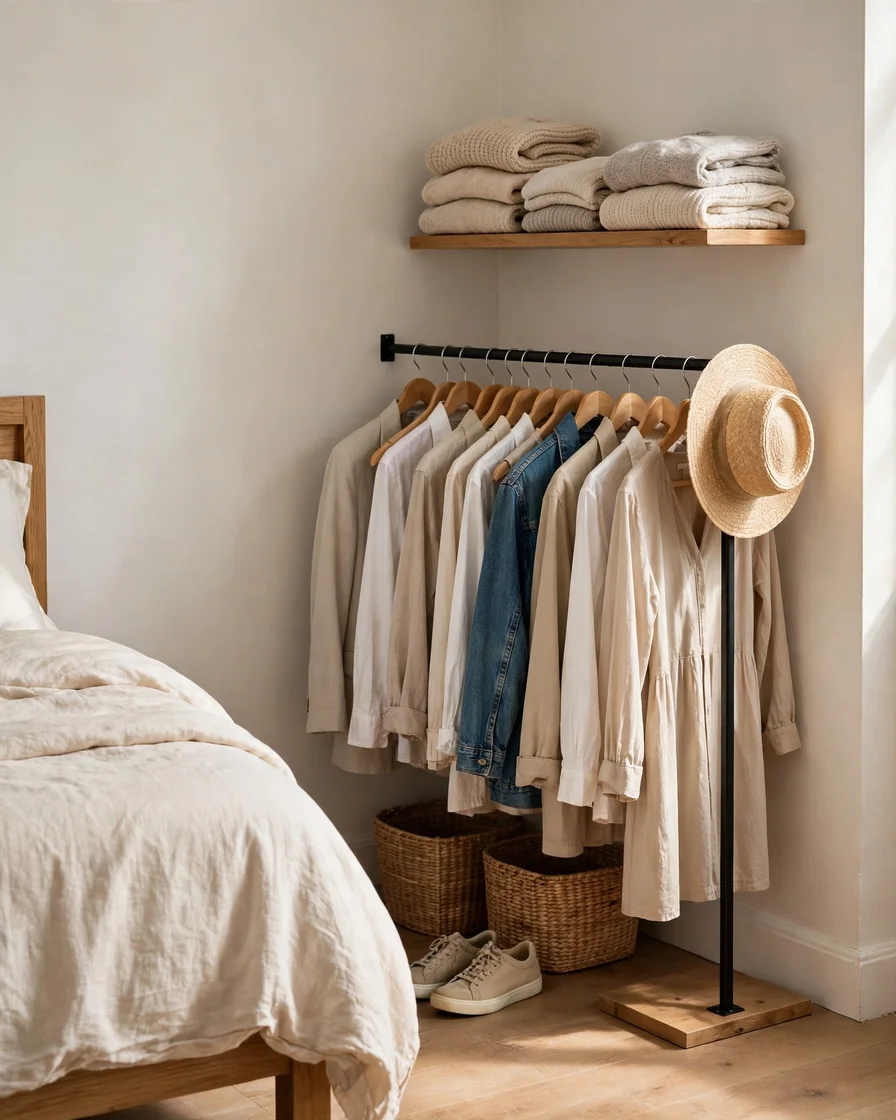
A bulky wardrobe can swallow a whole wall of a small bedroom, while an open clothing rail holds the same clothes in half the depth. In the photo, a slim black rail on a wooden base stands in a corner, holding a neat row of shirts, jackets, and dresses in white, beige, and denim on wooden hangers, with a straw hat on the end, folded knitwear above, and woven baskets and sneakers below. Measure the corner and sort your clothes down to what you actually wear — an open rail only looks good when it’s not crammed. Hang the longest pieces at one end and group by color so the rail reads like a display. Setup takes about an hour. For a cheaper route, a wall-mounted rail with two brackets and a wooden dowel does the same job for very little. For more ways to style a tight space, these small apartment decorating ideas pair well with an open wardrobe.
Quick Tip: Keep the rail to one layer of clothes — a second row behind the first turns it back into clutter.
15. Small Bedroom Apartment Ideas: Fit a Ladder Shelf in a Narrow Gap
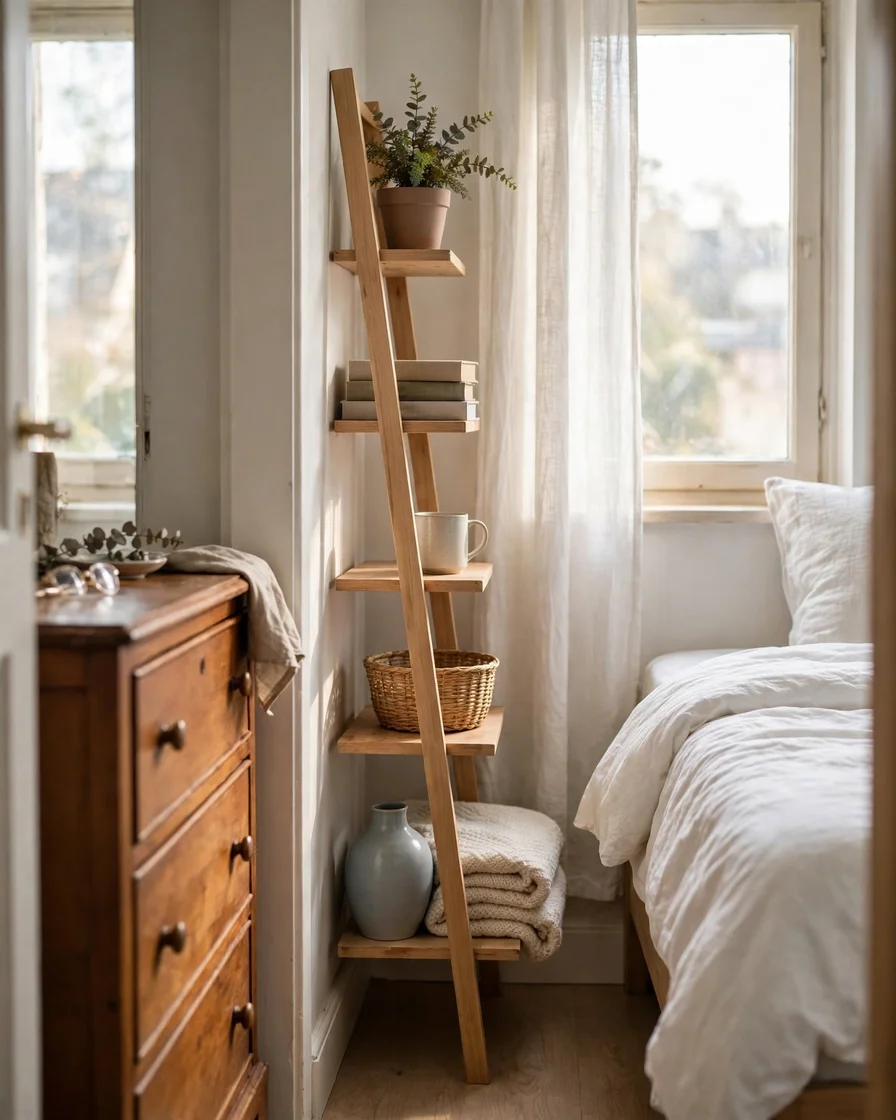
A ladder shelf is made for the gaps other furniture can’t use — the awkward strip between the dresser and the window, or beside the door. In the photo, a slim light wood ladder shelf leans in the narrow gap beside a wooden dresser, its five tiers holding a potted plant, a stack of books, a mug, a woven basket, a ceramic vase, and a folded blanket, with the bed’s white bedding just beside it. Measure the gap’s width and depth, then lean the shelf against the wall and secure the top with a small adhesive strip so it can’t slip. Put the heaviest items on the lowest shelf and the lightest on top so it stays balanced. Setup takes about 15 minutes, and the shelf comes down just as fast when you rearrange the room. For a cheaper route, a secondhand ladder shelf is easy to find, and a light sand and a coat of paint make it match any room.
Quick Tip: Leave one shelf half-empty — a ladder shelf packed edge to edge looks cluttered, not clever.
Expert Tips
- Measure every gap before you buy: Note the width, depth, and height of each empty strip — most small-bedroom wins come from furniture that fits a gap you already have.
- Go vertical before you go wider: Walls, the back of the door, and the space above the headboard hold more than any new piece of furniture, and they cost no floor space.
- One in, one out: Every time something new comes into a small bedroom, something old leaves — this one habit keeps every system on this list working.
- Keep some floor visible: A patch of bare floor in the middle of the room makes the whole space feel bigger than any mirror trick.
- Renters, skip the drill: Tension rods, adhesive hooks, leaning shelves, and over-the-door hooks do nearly everything here with zero holes to fill.
Final Thoughts
A small apartment bedroom doesn’t need a bigger room — it needs furniture that works harder and walls that do some of the storage. The easiest places to start are the over-the-door organizer, the rolling bins, and the leaning mirror, since each one takes under half an hour and needs no tools.
Pick one fix this weekend and see how the room changes. Once the first corner feels calm, the rest follows fast.
How do you arrange furniture in a small apartment bedroom?
Push the bed into a corner or against the longest wall to free up one clear walkway instead of two half-used ones. Put the tallest piece on the wall opposite the door and keep the middle of the room open. Measure first, and tape the layout on the floor before you move anything.
How can I add storage to a small bedroom without a closet?
Use the space you already have: rolling bins under the bed, a storage ottoman at the foot, floating shelves above the headboard, and an over-the-door organizer for small items. An open clothing rail replaces a wardrobe in half the depth, and a pegboard wall holds accessories that would otherwise fill a drawer.
What is the best bed for a small apartment bedroom?
A storage bed with drawers underneath is the best bed for a small apartment bedroom, because it holds as much as a dresser without taking extra floor space. A low-profile platform frame also helps the room feel taller. If you already own a bed, risers with rolling bins underneath give you the same storage.
How do I make a small bedroom look bigger?
Lean a full-length mirror opposite the window so it bounces light across the room, and keep the bedding and walls in light, matching tones. Choose furniture with visible legs so you can see floor underneath, and leave one patch of open floor in the middle of the room. Sheer curtains instead of heavy drapes also let in more daylight.
Can I decorate a small rented bedroom without drilling?
Yes — nearly everything in this article works without a single hole. Use tension rods for curtains, adhesive hooks and strips for shelves and art, leaning mirrors and ladder shelves, and over-the-door organizers for storage. When you move out, peel everything off, wipe the marks away, and the walls look untouched.