The smell of freshly brewed coffee drifting through the house is one of the simplest pleasures of a slow morning, and rustic coffee bar ideas turn that small ritual into a warm, welcoming corner of your home. With weathered wood, chunky ceramic mugs and jars lined up on a shelf, a rustic coffee station feels lived-in, honest and calm — a place to pause before the day begins.
From reclaimed-wood shelves and vintage sideboards to rolling carts and tiny window nooks, these styles suit kitchens, dining corners and small apartments, with plenty of budget-friendly and easy DIY options. Whether you love farmhouse charm or a simpler wood-and-metal look, you will find a setup here to copy and make your own.
1. Reclaimed Wood Floating Shelves With Hanging Mugs
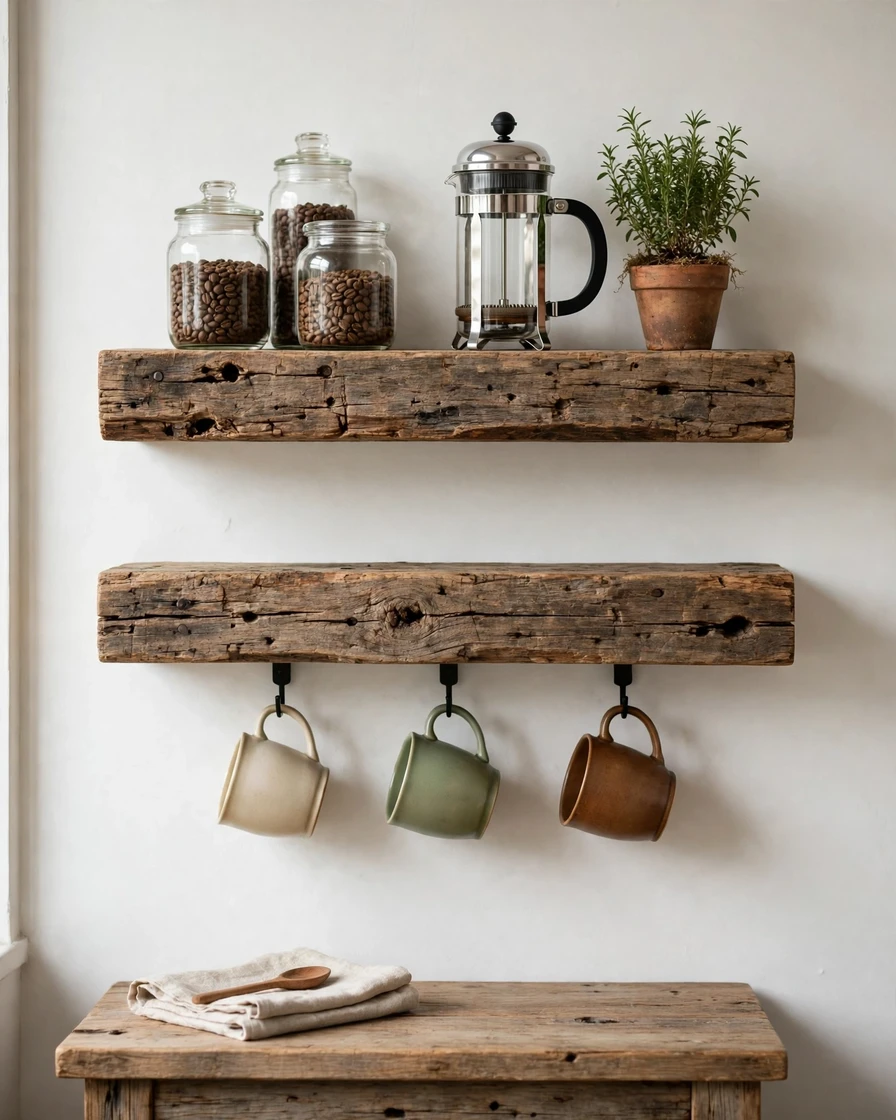
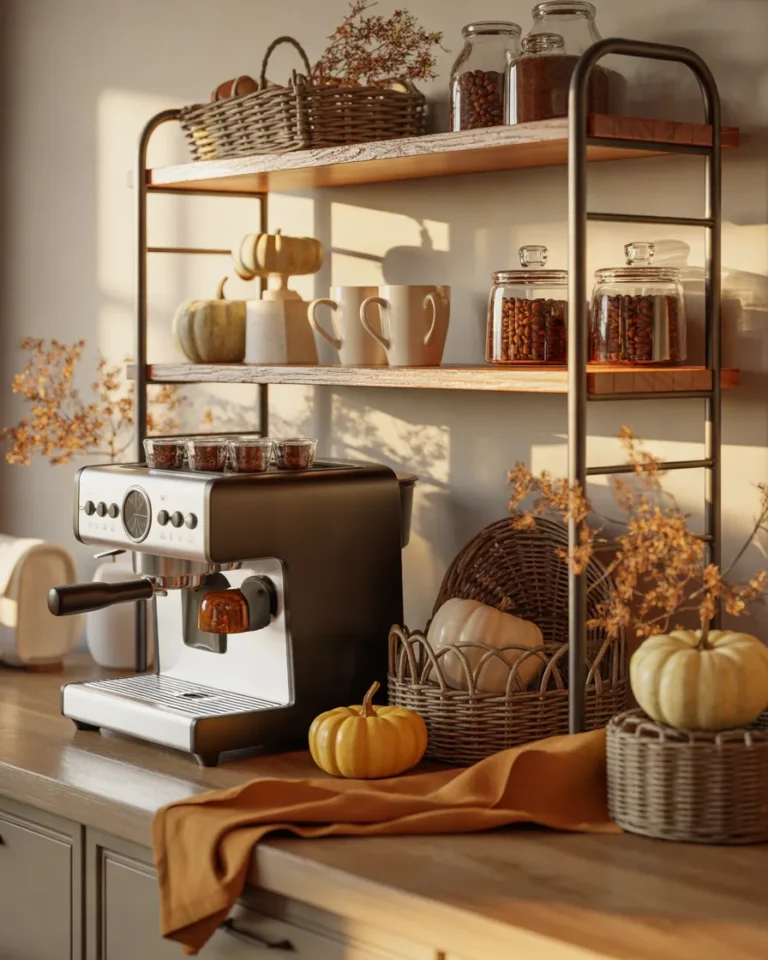
Two thick planks of reclaimed wood float on a plain wall above a counter, their knots, grain and uneven edges giving the whole corner instant character. Ceramic mugs in cream, sage and warm brown hang from black hooks screwed into the underside of the lower shelf, while the top shelf holds glass jars of coffee beans, a French press and a potted herb. The open display keeps everything visible and easy to grab, and the natural wood tones make a plain white wall feel warm.
Start by choosing a blank stretch of wall near an outlet, then mount two shelves about 40 centimetres apart using hidden brackets rated for the weight. Look for reclaimed boards at salvage yards or ask a local carpenter for offcuts, and sand them smooth before sealing with food-safe wood oil. Screw in cup hooks evenly spaced along the lower shelf, then hang your favourite mugs and keep beans and filters on the top shelf.
Quick Tip: Mix mug colours but keep them in the same warm, earthy palette so the open shelves look styled rather than cluttered.
2. A Coffee Bar on a Vintage Wooden Sideboard
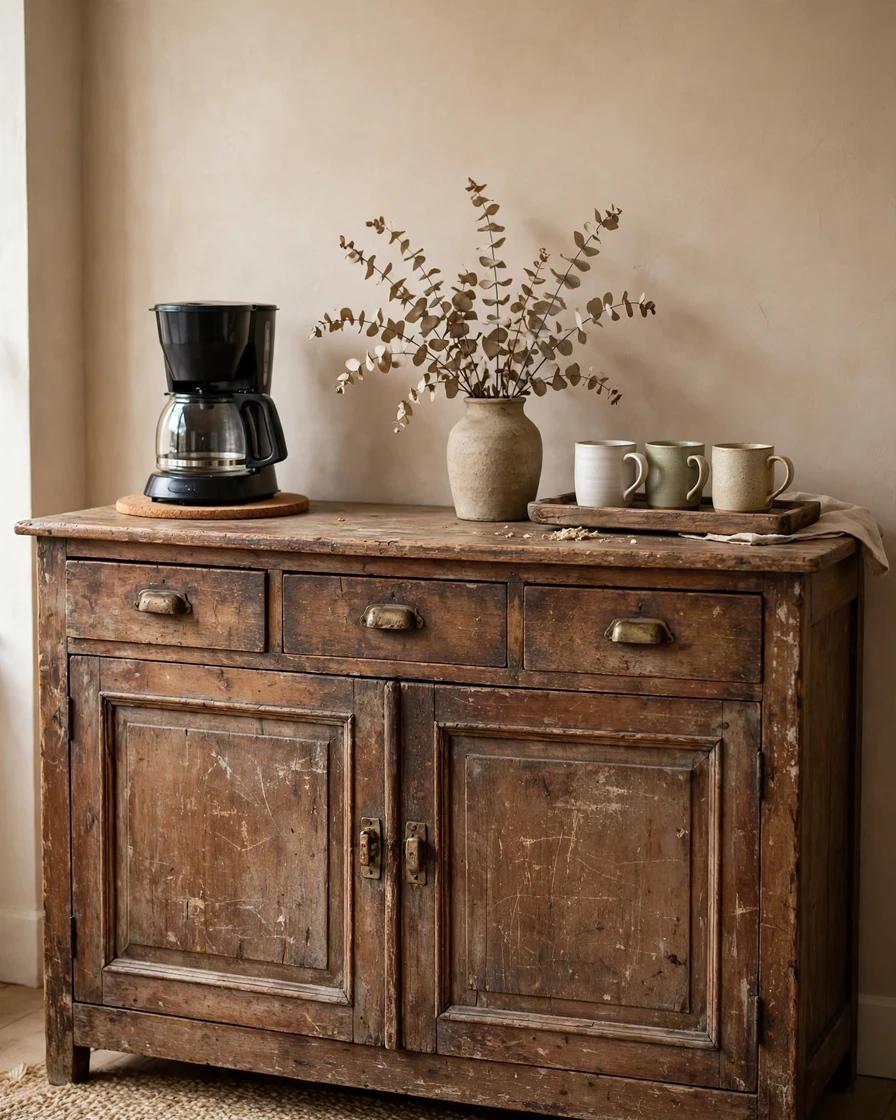
A worn wooden sideboard with drawers and cupboard doors becomes the heart of this coffee bar, its scratched top and aged patina telling a story no new furniture can match. A drip coffee maker sits at one end, a tray of mugs at the other, and a vase of dried eucalyptus fills the middle. The drawers hide filters, spare pods and tea bags, while the top stays clear enough for daily brewing. It feels like a piece that has always belonged there.
Hunt for a second-hand sideboard at a thrift shop, flea market or online marketplace, and check that the drawers slide smoothly before you buy. Clean it well, tighten any loose handles, and add a coat of clear wax to protect the top from spills. Place it against a kitchen or dining-room wall near a plug, set your coffee maker on a cork mat to guard against heat, and keep only daily essentials on top.
Quick Tip: Line the drawers with kraft paper or washable liners so coffee grounds and sugar spills wipe up in seconds.
3. A Galvanized Metal Tray With Bean Jars and Mugs
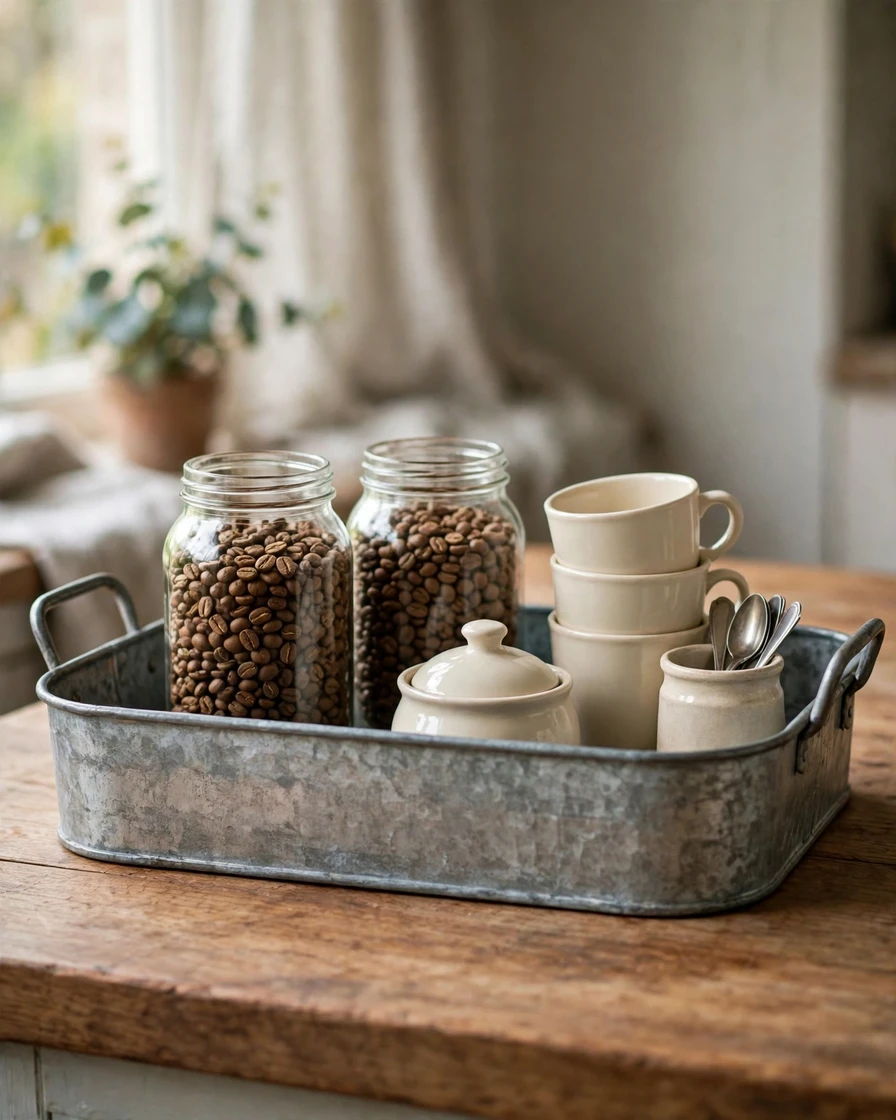
A large galvanized metal tray with raised edges gathers the whole coffee station onto one tidy surface, its silvery, slightly weathered finish contrasting beautifully with warm wood beneath. Inside sit two glass jars of whole beans, a small stack of ceramic mugs, a sugar bowl and a spoon holder, everything within arm’s reach. The tray catches drips and stray grounds, so the counter underneath stays clean, and the industrial metal edge adds a farmhouse touch without any building work.
Choose a tray big enough to hold your maker or kettle plus jars, then place it on a counter, sideboard or open shelf as the base of your coffee corner. Fill clear glass jars with beans, ground coffee and sugar so you can see when supplies run low, and add a small ceramic dish for spoons. Keep the palette simple — metal, glass and wood — and leave a little empty space on the tray so it never looks crowded.
Quick Tip: Pick a tray with handles so you can lift the whole station aside when you wipe down the counter.
4. A Small Chalkboard Menu Above the Station
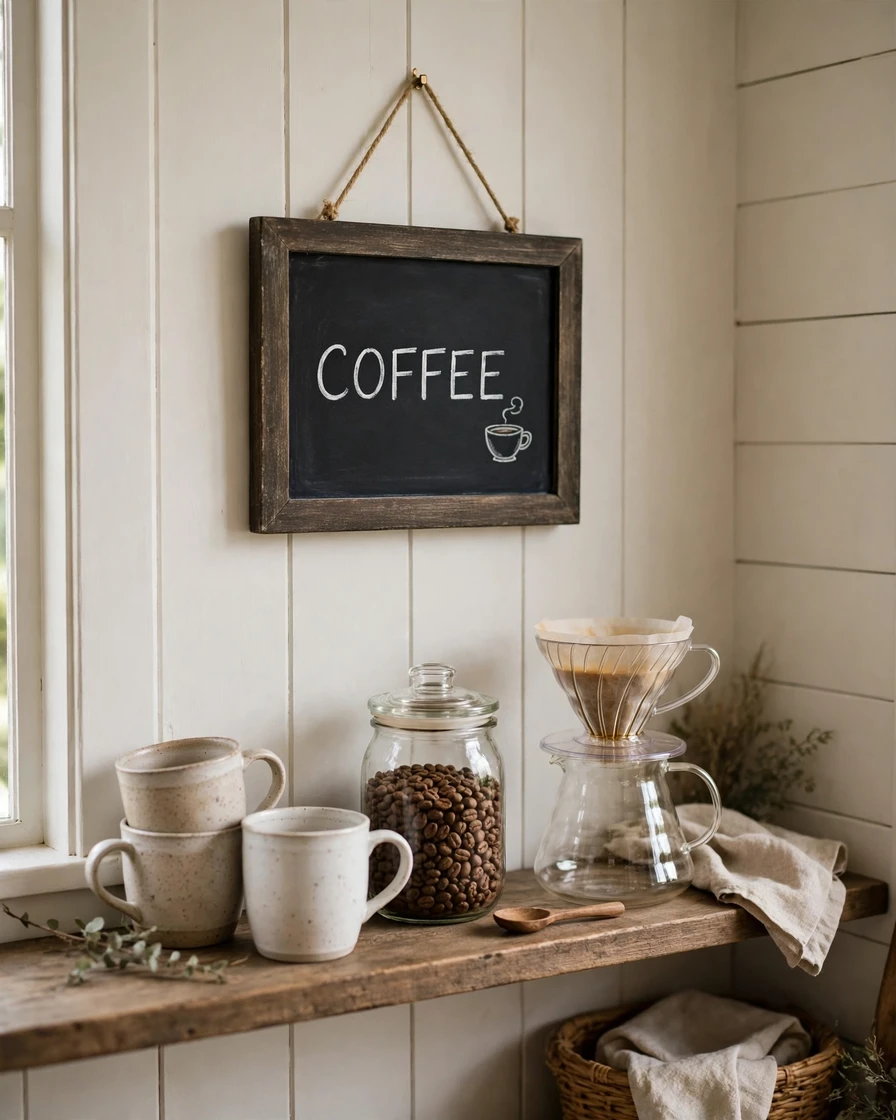
A small framed chalkboard hangs just above the coffee station, its dark surface showing the single word COFFEE in clean, simple lettering with a tiny hand-drawn cup beside it. Below it, a wooden shelf holds mugs, a jar of beans and a pour-over dripper, so the little sign turns an ordinary corner into a place that feels like a tiny neighbourhood café. The chalkboard adds personality without taking up any counter space at all.
Buy a ready-made chalkboard or make one by painting a small wooden board with chalkboard paint and adding a simple frame. Hang it at eye level above your coffee bar using a picture hook, then write the word with a chalk marker for crisp lines that will not smudge. Change the lettering style or add a small cup sketch whenever you fancy a refresh, and keep the rest of the station simple so the board stays the focal point.
Quick Tip: Use a liquid chalk marker instead of loose chalk for neat lettering that survives kitchen steam.
5. Mason Jar Storage for Beans, Sugar and Stirrers
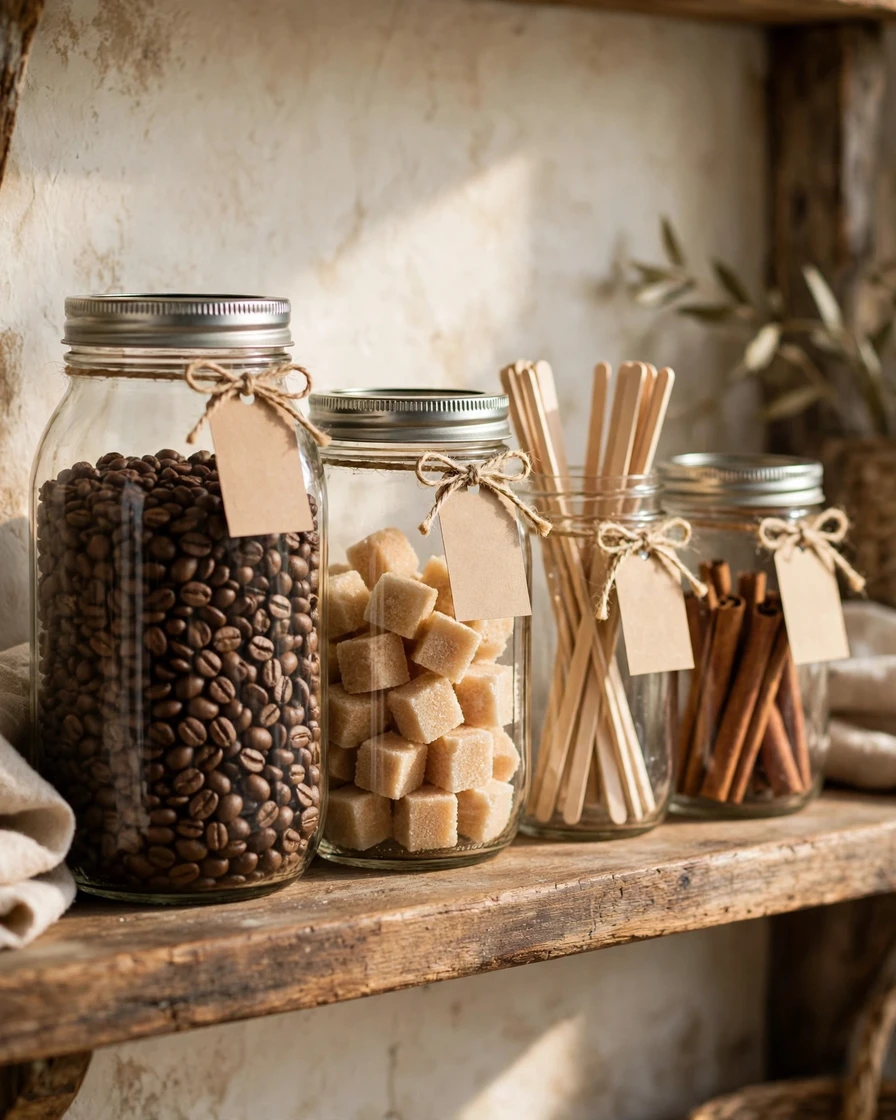
A row of clear mason jars with metal lids lines a wooden shelf, each one filled with something useful: dark roasted beans, raw sugar cubes, wooden stirrers and cinnamon sticks. The glass shows off the rich colours and textures inside, turning plain storage into part of the decoration, while the metal lids keep everything fresh and sealed. Labels tied on with twine add a handmade farmhouse finish that costs almost nothing.
Gather mason jars in two or three sizes, wash and dry them thoroughly, then fill the largest with beans, a medium one with sugar and smaller ones with stirrers, tea bags or cocoa powder. Set them on a shelf or tray in a neat row, tallest at the back, and tie a small kraft-paper tag around each neck with twine. Buy jars in bulk at a grocery or hardware store to keep the cost low, and keep spare lids on hand.
Quick Tip: Store beans in a jar with a tight-sealing lid away from direct sunlight so they stay fresh for longer.
6. Wooden Crate Shelves for Coffee Supplies
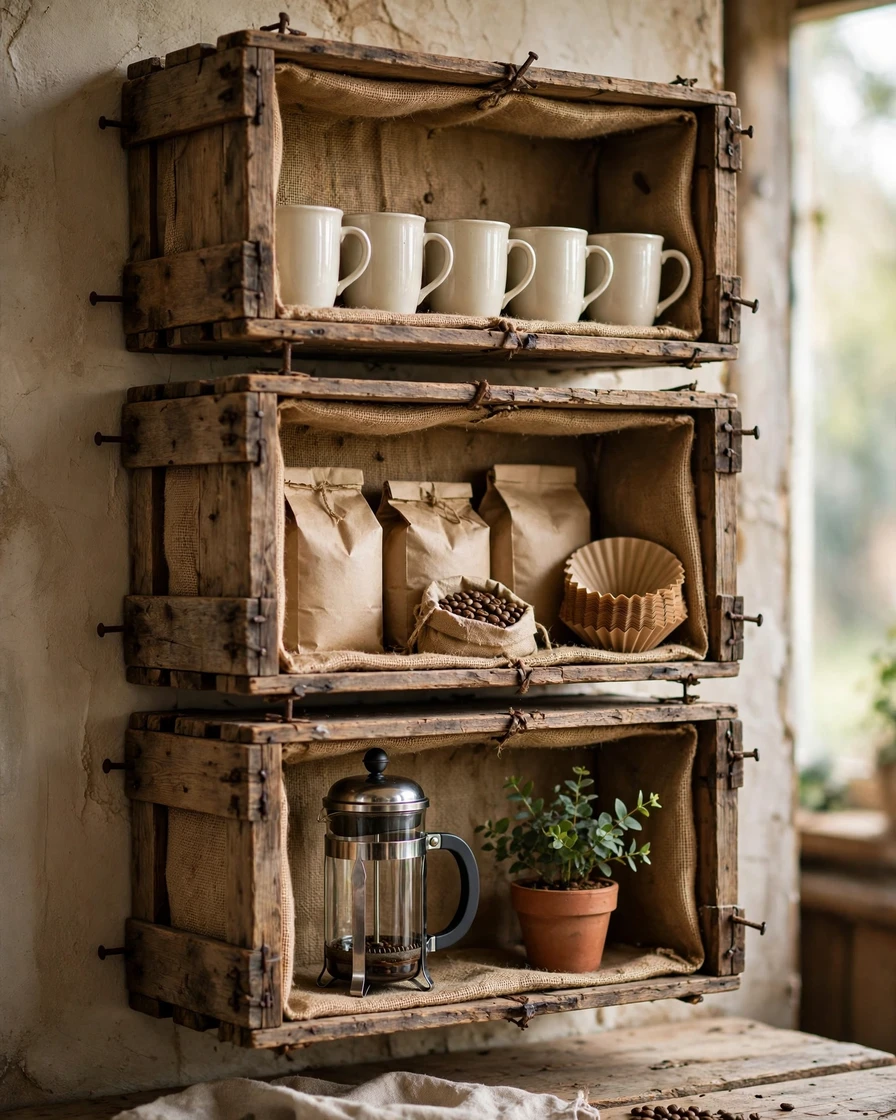
Old wooden crates, turned on their sides and stacked on the wall, become open cubby shelves with a wonderfully rustic, market-stall feel. Each crate holds something different: one cradles a row of mugs, another stores bags of beans and filters, and a third keeps a French press and a small plant. The rough wood, visible nails and stamped markings give the coffee corner texture and charm, and the open boxes make it easy to see everything at a glance.
Source sturdy wooden crates from a craft store, fruit market or online seller, and sand any rough edges before use. Mount them securely to wall studs with screws, stacking two or three in a pleasing arrangement, or simply stack them on a countertop if you rent. Line the inside of each crate with a scrap of burlap or kraft paper, then group supplies by type so each cubby has one clear job.
Quick Tip: Fix crates to the wall with at least two screws each so heavy mugs and jars never pull them loose.
7. A Rolling Rustic Coffee Bar Cart
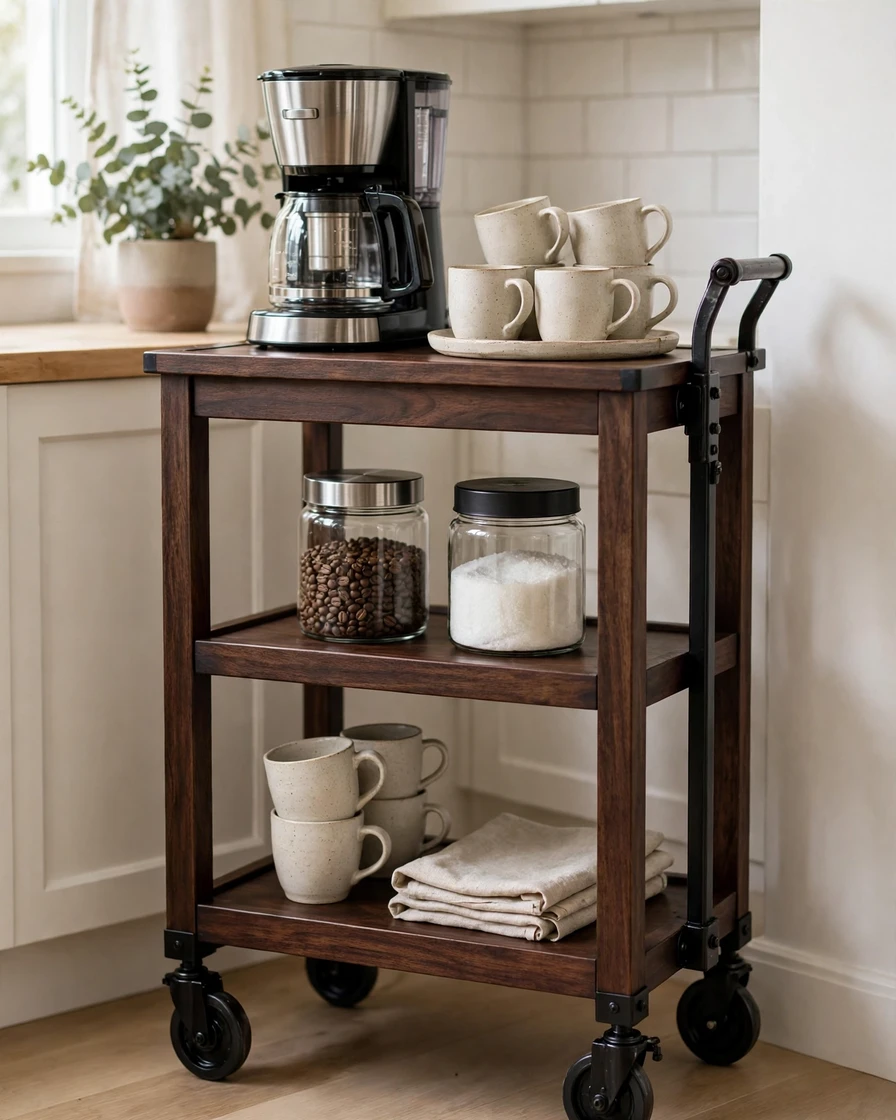
A small rolling cart built from dark wood and black metal wheels holds the whole coffee setup and can move wherever the morning takes you. The top shelf carries a coffee maker and a tray of mugs, the middle shelf holds jars of beans and sugar, and the bottom shelf stores extra cups and a folded linen towel. Its compact footprint suits small kitchens, and the wheels mean you can roll it to the dining table when guests come over.
Look for a bar cart or kitchen trolley with at least two shelves and a sturdy frame, or repurpose an old utility cart with a coat of wood stain. Place heavier items like the coffee maker on the top shelf and lighter supplies below, and keep the power cord wrapped around a hook on the side. Park the cart in a free corner near an outlet, and lock the wheels once it is in place.
Quick Tip: Choose a cart with a handle on one side so it is easy to steer through a narrow kitchen.
8. Mug Hooks Under a Wooden Shelf With Twine and Burlap Details
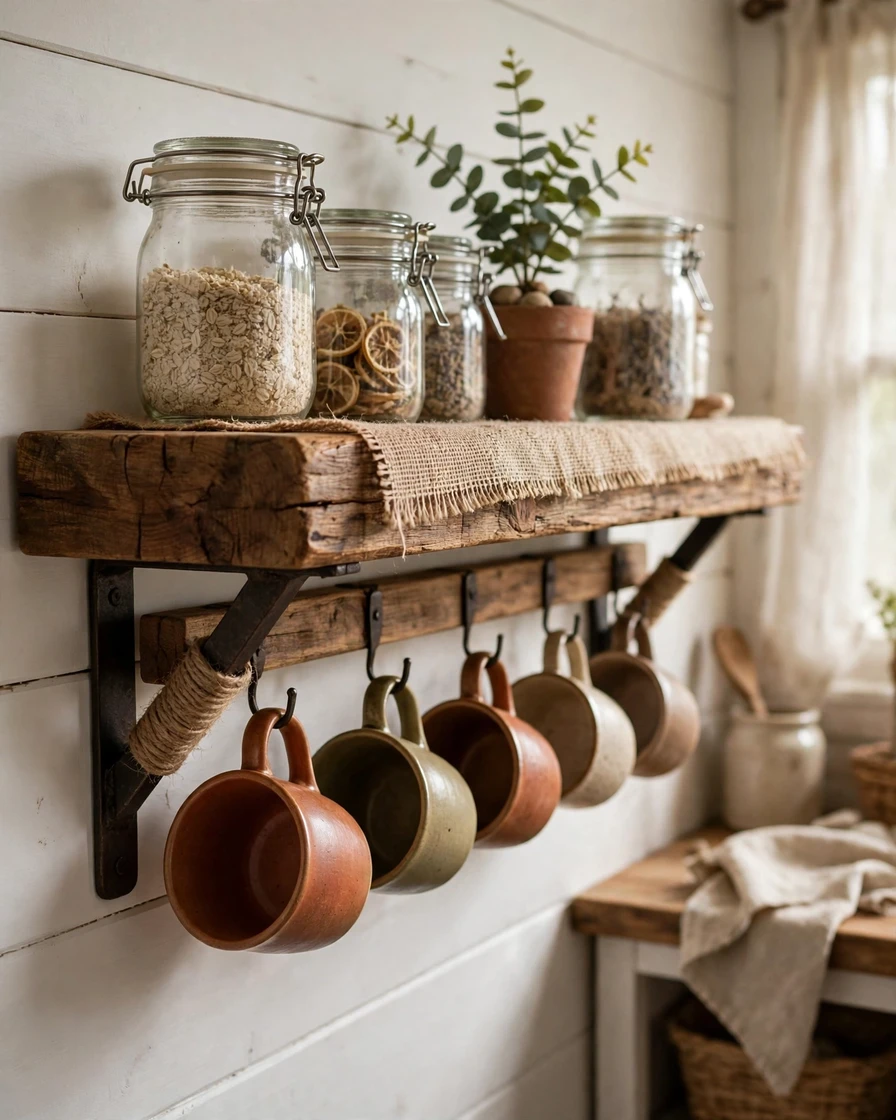
A chunky wooden shelf mounted on the wall does double duty in this idea, with mugs hanging from hooks underneath and jars and a small plant arranged on top. Lengths of twine are wrapped around the shelf brackets, and a strip of burlap runs along the shelf edge like a tiny runner, softening the wood with natural texture. The hanging mugs become the decoration themselves, swaying gently and showing off their colours and shapes.
Fit a solid wooden shelf with strong brackets, then screw a row of cup hooks into its underside, spaced about eight centimetres apart. Wrap twine around each bracket a few times and tie it off neatly, then cut a strip of burlap to the shelf’s length and fix it along the front edge with small pins or double-sided tape. Hang mugs by their handles, heaviest nearest the brackets, and keep the shelf top uncluttered.
Quick Tip: Hang your most-used mugs in the middle and decorative ones at the ends so daily reach is easy.
9. A Farmhouse Coffee Nook on a Small Wooden Table by a Window
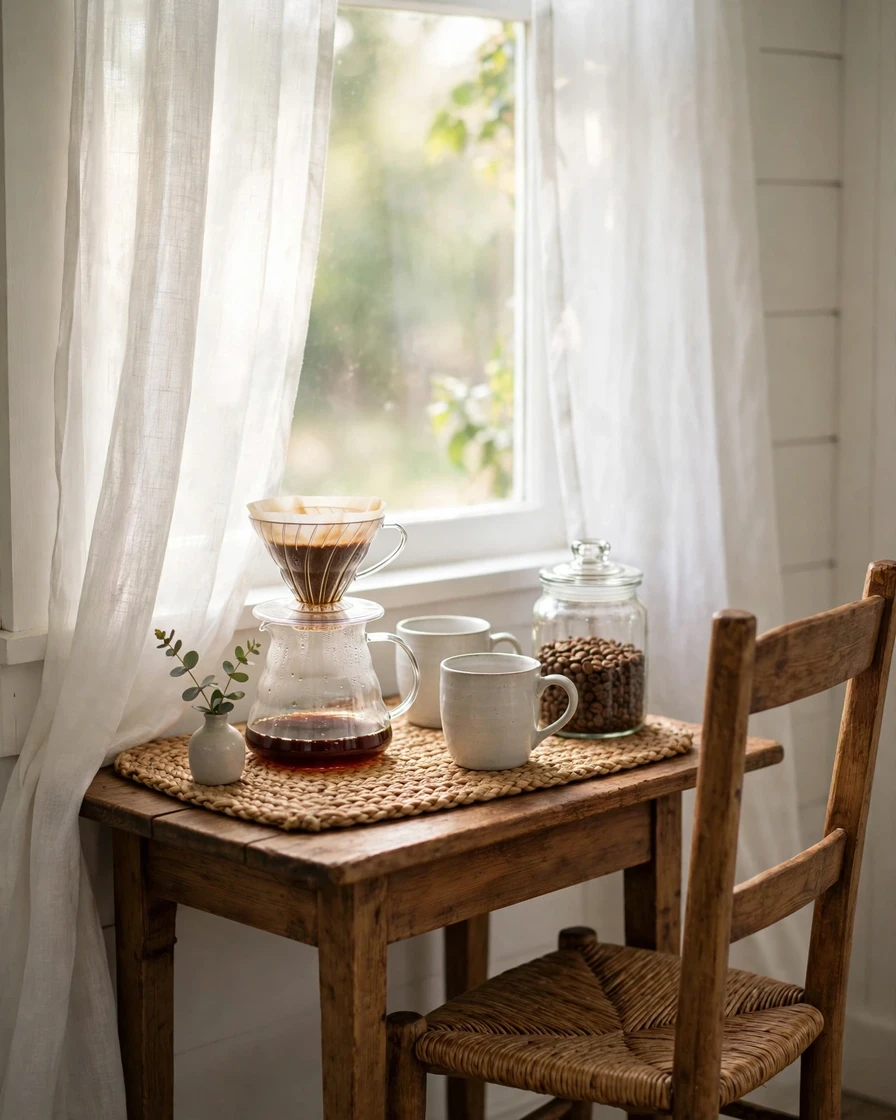
A small wooden table tucked beneath a bright window becomes the sweetest coffee nook, bathed in soft morning light. On it sits a pour-over set, two or three ceramic mugs, a jar of beans and a tiny vase with a sprig of greenery, while a woven placemat protects the wood from hot cups. A single wooden chair pulled up beside it invites a slow sit-down, and the view outside does the rest. It is the simplest coffee bar of all, and often the most loved.
Find a small table that fits your window space — a thrifted side table or a folding table works well — and place it where morning light falls. Add a woven placemat or cork trivet under the brewer, then arrange just the essentials: your coffee maker or pour-over, mugs, beans and sugar. Keep a chair nearby and a small basket underneath for extra filters and napkins.
Quick Tip: A sheer curtain softens harsh sunlight and stops the tabletop from fading over time.
10. A Tiered Wooden Stand for Cups, Spoons and Syrups

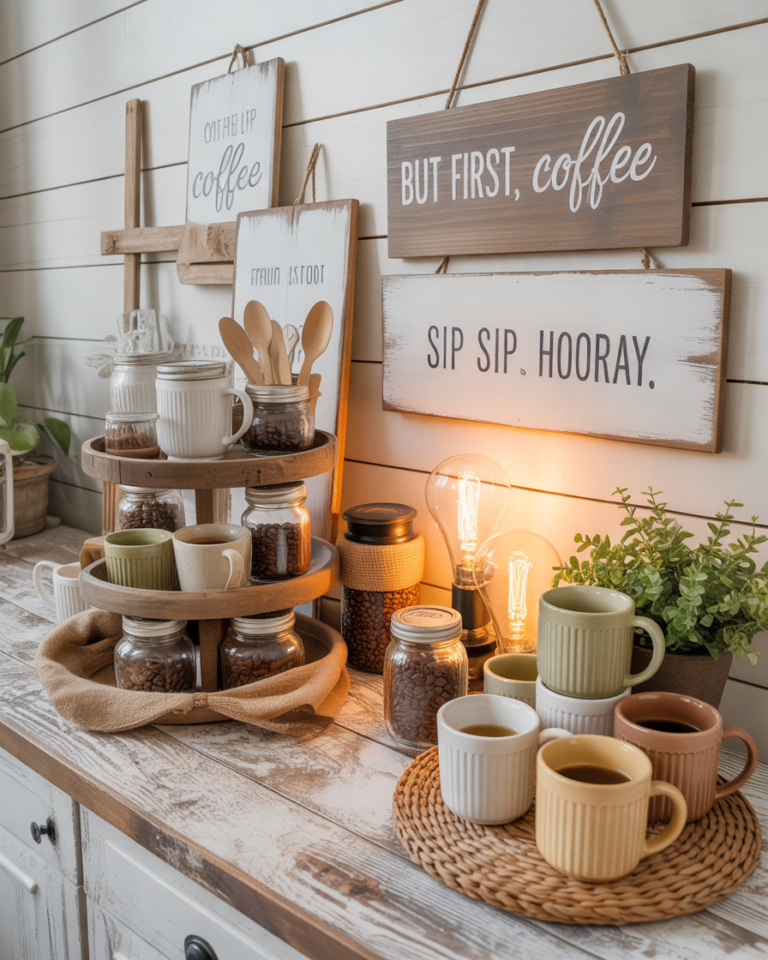
A three-tiered wooden stand, like a cake stand made from round boards and turned legs, organises the coffee bar vertically and saves precious counter space. The top tier holds small cups and espresso glasses, the middle tier carries spoons, stirrers and sugar cubes in little dishes, and the bottom tier fits bottles of vanilla and caramel syrup. Everything is visible at a glance, and the warm wood tiers look like a display in a country café.
Buy a ready-made tiered stand from a home store, or build one from three round wooden boards and short dowels glued between them. Place it beside your coffee maker on the counter, then sort items by height: short cups on top, small dishes in the middle and taller syrup bottles at the bottom. Keep the stand close to the brewer so making a flavoured latte takes only a few steps.
Quick Tip: Keep syrup bottles on the bottom tier so drips fall on the stand, not on your cups.
11. A Coffee Bar Inside a Repurposed Armoire or Hutch
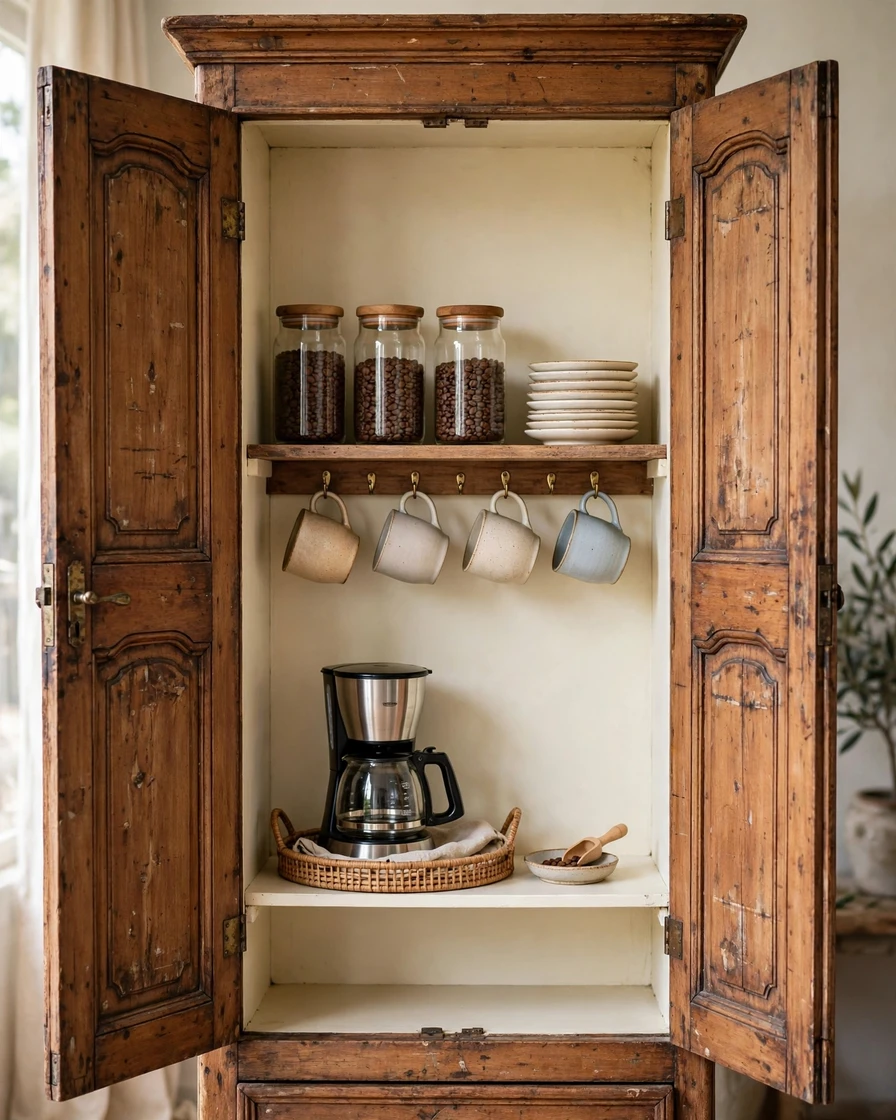
An old armoire or hutch, its doors thrown open, hides a complete coffee bar inside — and closes up neatly when the day is done. Shelves inside hold the coffee maker, mugs hung from hooks, jars of beans and a stack of saucers, while the back panel, painted a soft cream, makes everything glow. It is perfect for open-plan rooms where you want a coffee station without a permanent countertop display.
Find a second-hand armoire or hutch with deep shelves and sturdy doors, and clean it thoroughly inside and out. Remove any unwanted dividers, add a coat of paint or wood stain, and drill a small hole in the back panel for the coffee maker’s power cord. Fit cup hooks under one shelf, arrange jars and mugs by height, and add a small tray under the brewer to catch drips.
Quick Tip: Leave the doors open while brewing so steam escapes, then close them to keep dust off your cups.
12. Woven Baskets for Pods, Filters and Napkins
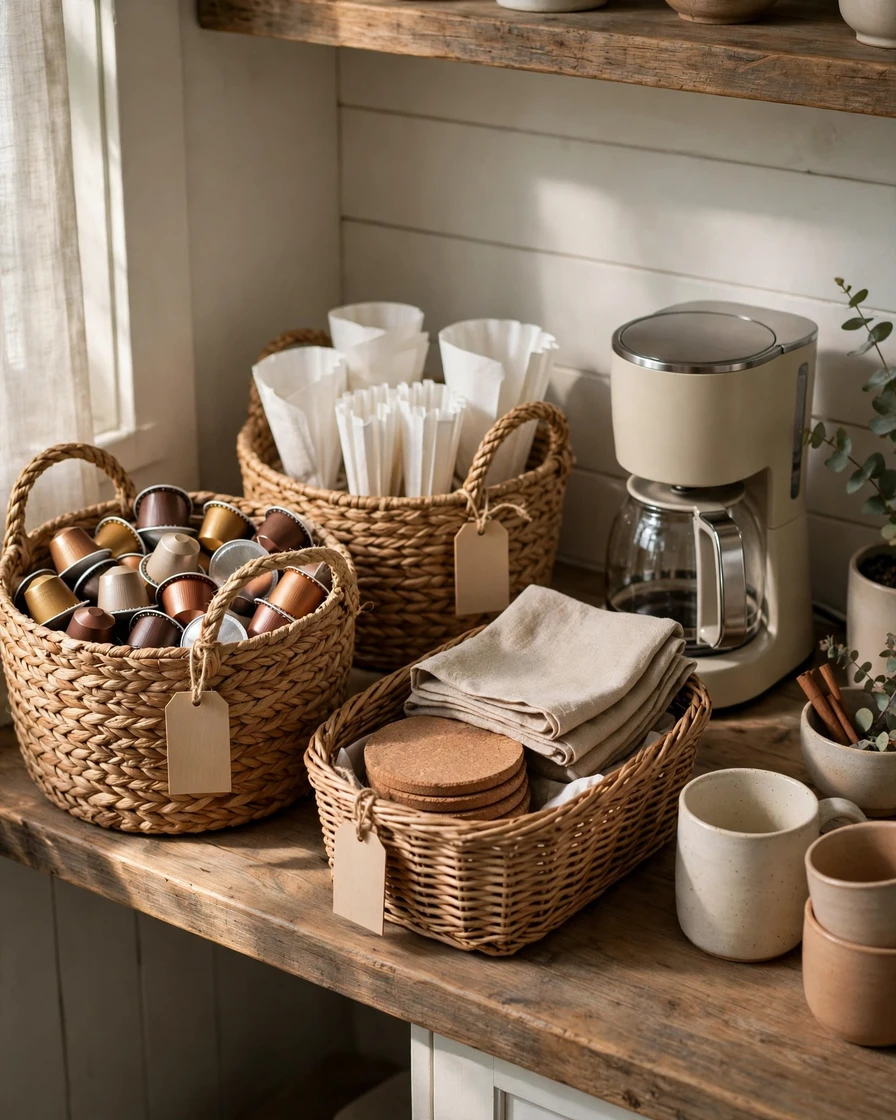
A set of woven seagrass and wicker baskets brings soft, natural texture to the coffee bar while hiding all the small bits and pieces. One basket holds coffee pods, another keeps paper filters upright, and a third stores folded napkins and linen coasters, each labelled with a small wooden tag. The warm woven tones sit beautifully beside wood and ceramic, and the baskets make tidying up as simple as tossing things back in.
Choose three baskets in different sizes but the same natural material, and place them on an open shelf or beside the coffee maker. Sort supplies by type — pods in one, filters in another, napkins in the third — and add a small tag to each so guests can help themselves. Pick baskets with a tight weave so small pods do not slip through, and wipe them with a dry cloth now and then.
Quick Tip: Line the pod basket with a small cloth napkin so pods stay tidy and the basket stays clean.
13. A Hand-Painted Wooden "COFFEE" Sign Above the Bar
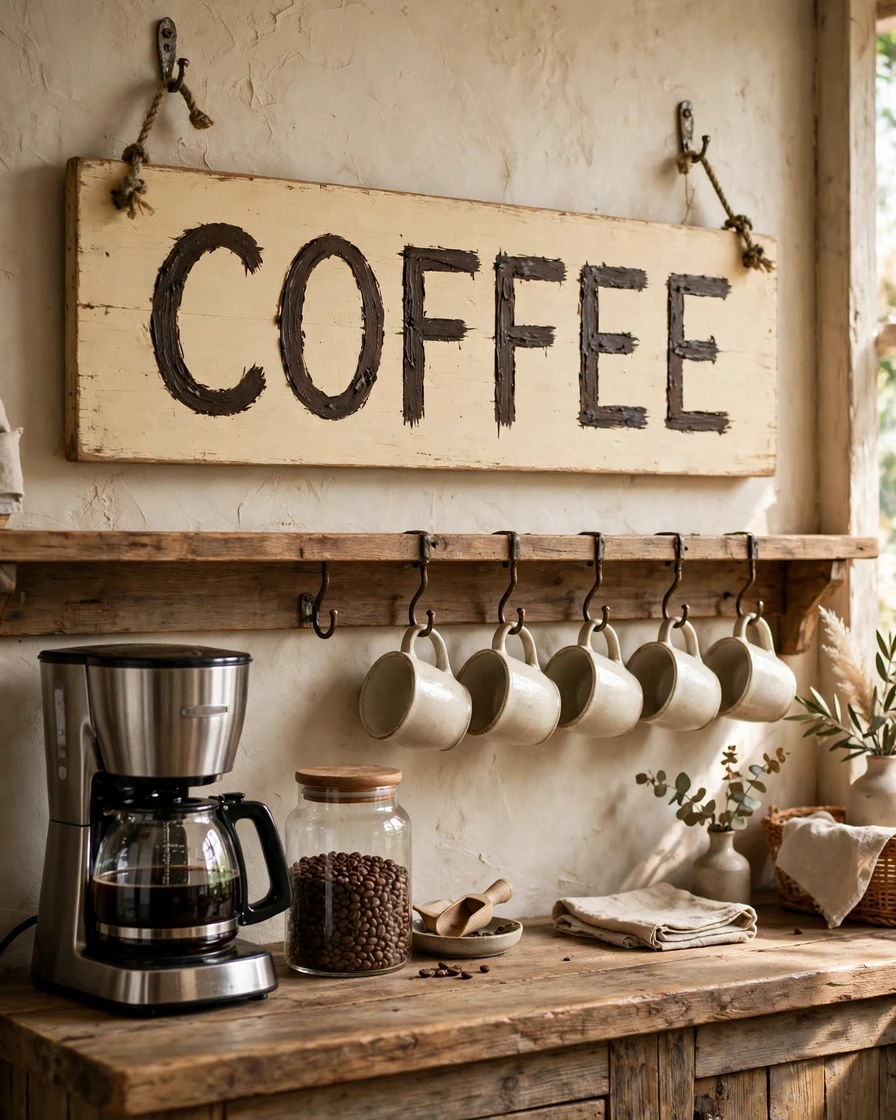
A long wooden board painted in a warm cream colour hangs above the coffee bar, the word COFFEE hand-painted across it in large, simple dark-brown letters. Below the sign, a wooden counter holds a coffee maker, a row of hanging mugs and a jar of beans, and the sign pulls the whole corner together like a shopfront. The slightly imperfect brushstrokes are part of its charm, giving the station a handmade, farmhouse feel.
Cut or buy a pine board about sixty centimetres long, sand it smooth and paint it with two coats of chalk paint in cream or soft white. Sketch the word COFFEE lightly in pencil, then fill it in with dark-brown acrylic paint using a flat brush, keeping the letters bold and simple. Seal with clear wax, hang it above the bar with picture hooks, and keep the shelf below uncluttered.
Quick Tip: Practise the lettering on paper first so the spacing looks even across the board.
14. A Copper Kettle and Mugs on a Wooden Counter
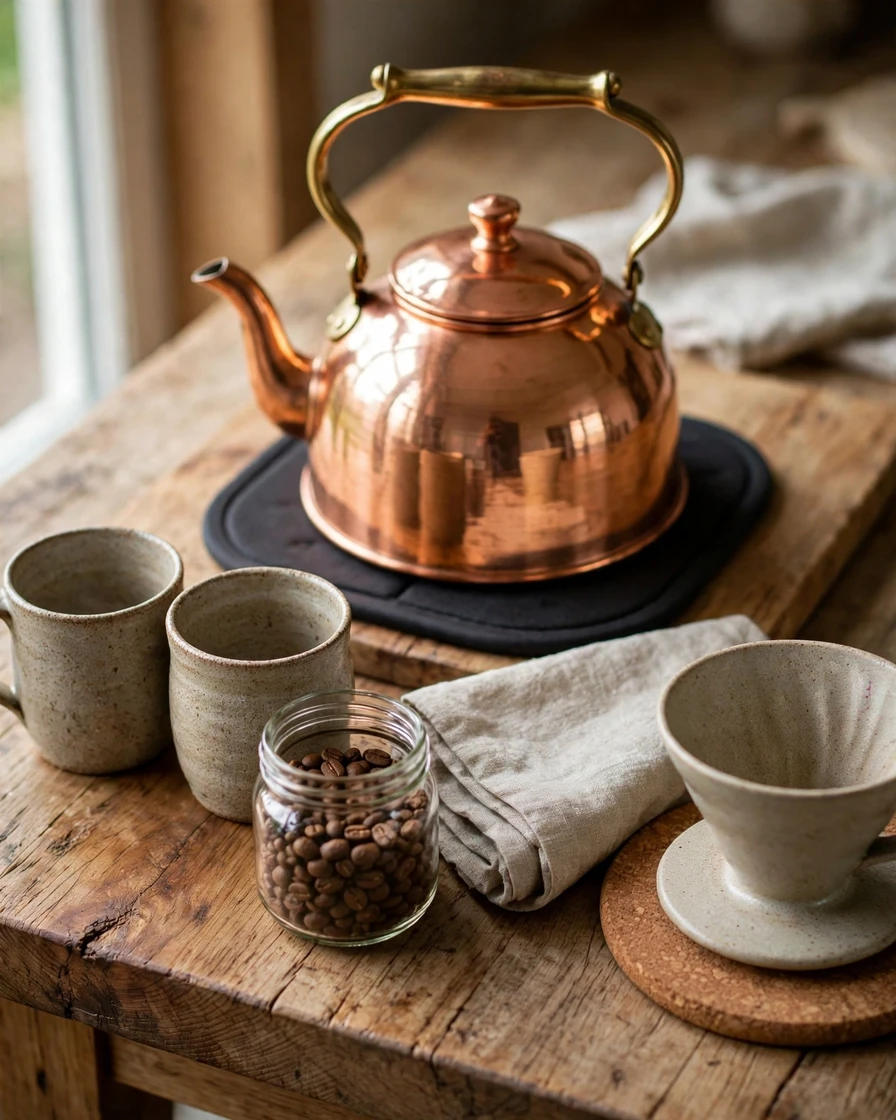
A gleaming copper kettle takes centre stage on a thick wooden counter, its warm metallic glow echoing the wood grain beneath it. Beside it stand two or three handmade ceramic mugs, a small jar of loose coffee beans and a folded linen cloth, while a pour-over dripper waits on a trivet. The mix of copper, clay and wood feels rich and earthy, and the kettle’s gentle whistle becomes part of the morning ritual.
Set a wooden chopping board or thick countertop section as the base of your station, then place the kettle on a heat-proof trivet at one end. Arrange mugs and a jar of beans beside it, and keep the pour-over or French press within easy reach. Polish the copper occasionally with a lemon-and-salt rub to keep its shine, or let it develop a natural patina if you prefer a softer, aged look.
Quick Tip: Always set a hot kettle on a trivet or cork mat so the wood underneath never scorches.
15. A Subtle Seasonal Touch: Cinnamon Sticks, a Pine Sprig and a Plaid Runner
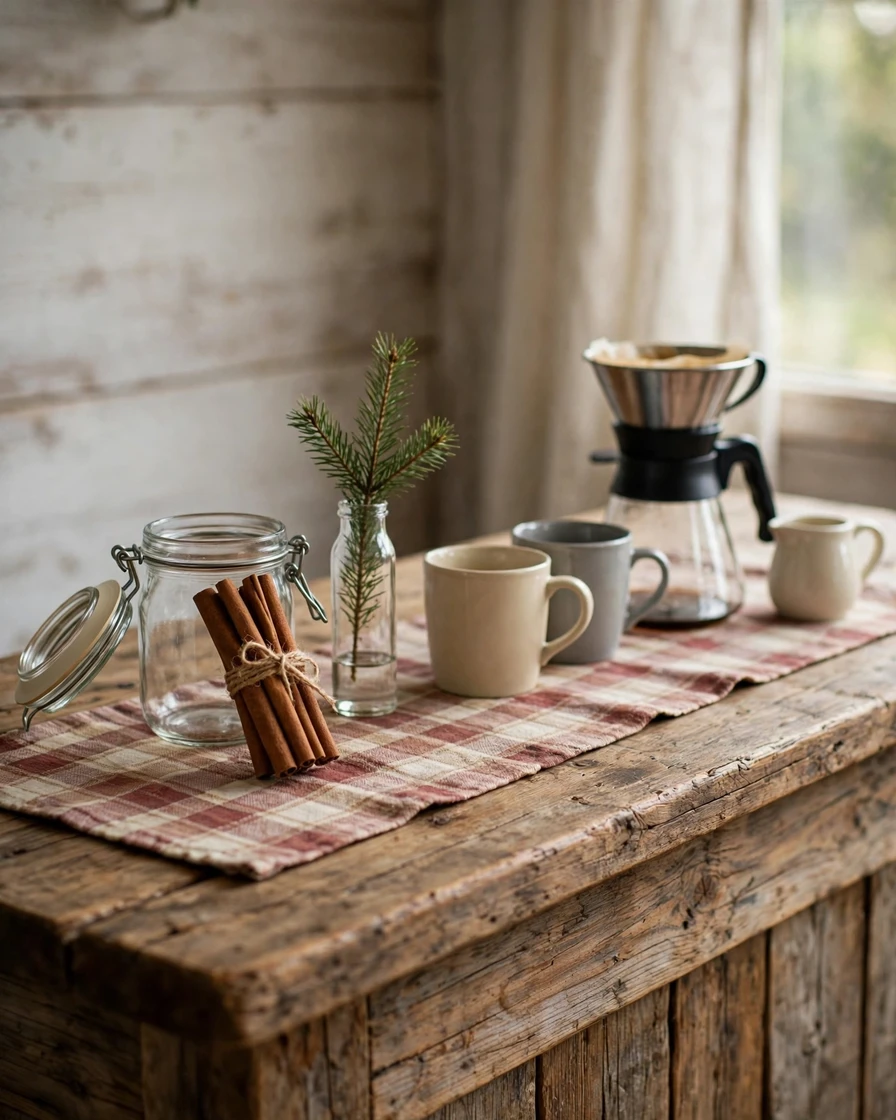
The coffee bar stays rustic and year-round, with just one quiet seasonal accent: a plaid runner in muted red and cream laid along the wooden counter, a small bundle of cinnamon sticks tied with twine beside the mugs, and a single fresh pine sprig tucked into a small jar. The effect is gentle and understated — a hint of the cooler months without any fuss — and the cinnamon adds a soft, warm scent every time you lift a mug.
Lay a plaid table runner along the counter under your coffee maker and mugs, choosing muted tones that match the wood rather than bright colours. Tie three or four cinnamon sticks together with twine and lean them against a jar, then add one small pine sprig in a narrow jar or bottle. Swap the sprig for fresh greenery every week or two, and remove the runner whenever you want the bar back to everyday plain.
Quick Tip: Keep the seasonal pieces to these three small touches so the bar still feels calm and uncluttered.
Final Thoughts
A rustic coffee bar is less about buying new things and more about gathering warm, honest pieces that make your mornings slower and kinder. Start with just one idea from this list — a shelf, a tray or a small table — and build from there at your own pace, letting the corner grow as you find pieces you love. With a little wood, a few good mugs and your favourite beans close at hand, even the busiest morning begins with a quiet moment of calm.
How much space do I need for a rustic coffee bar?
You need very little space to start. A single shelf, a small tray on an existing counter or a corner of a sideboard is enough for a coffee maker, a few mugs and your beans. Many of the ideas in this list, like the rolling cart or the window nook, are designed for small kitchens and apartments.
What wood works best for a rustic coffee station?
Reclaimed wood, pine and oak all suit a rustic coffee station beautifully. Reclaimed boards bring the most character with their knots and grain, while pine is affordable and easy to stain or paint. Always seal wood near a coffee maker with oil or wax to protect it from steam and spills.
How do I keep a small coffee bar from looking cluttered?
Give every item a home and keep only daily essentials on display. Use trays, baskets and jars to group supplies, hang mugs on hooks instead of stacking them, and leave a little empty space on each shelf. A quick tidy each evening keeps the corner calm.
Can I build a rustic coffee bar on a budget?
Yes, most of these ideas are budget-friendly. Thrift shops, flea markets and online marketplaces are great sources for sideboards, crates and vintage mugs, and simple DIY projects like a chalkboard sign or crate shelves cost very little. Start small and add pieces over time.
How do I style a coffee bar without making it look like a café?
Keep the styling personal and homely rather than commercial. Use your own favourite mugs, a small plant or a family photo, and avoid too many signs or matching sets. One sign or chalkboard is plenty, and natural materials like wood, linen and ceramic keep the corner feeling like home.